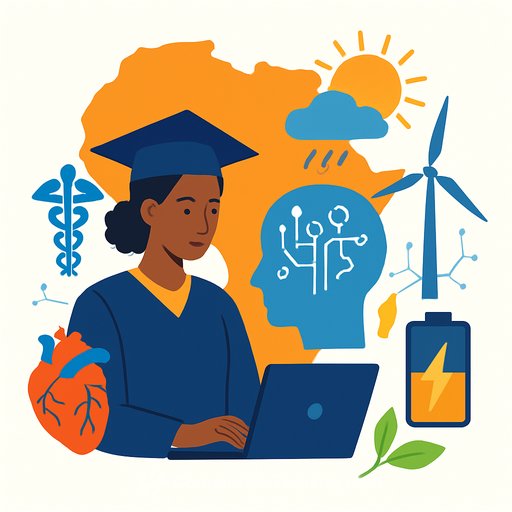
AI for Science Master's Program Seeks Africa's Next Generation of Innovators
Submissions are open for the AI for Science Master's Program in Africa. The goal is clear: build local scientific strength by training researchers who use AI to solve high-stakes problems in health, climate, energy, and materials.
This is more than coursework. It's a path to develop talent that contributes to global discovery with an African perspective and African priorities.
Program vision and academic focus
The curriculum blends AI fundamentals with applied scientific research and training in AI Research practices. Students build skills in machine learning, Data Analysis, and computational modeling and then apply them to real research questions.
Expect a strong emphasis on problem-solving, research integrity, and collaboration. Responsible use of AI is core, with work anchored in Africa's development needs. For context on ethics in AI, see the UNESCO Recommendation on the Ethics of AI.
Opportunities for African students and researchers
The program offers advanced training without leaving the continent, helping reduce brain drain and building durable research networks. Graduates will be competitive for roles in academia, industry, and policy.
Skills translate directly to projects like disease modeling, environmental monitoring, and resource optimization. The program also encourages broader participation so more voices help set research agendas.
Broader impact on science and innovation in Africa
Integrating AI into scientific workflows can raise research efficiency and visibility for African institutions. That strengthens international collaboration while keeping local needs at the center.
Over time, the program can help create a critical mass of AI-literate scientists-people who publish, partner, and build labs that drive long-term progress and economic value.
Key features
- Curriculum - AI combined with scientific research
- Skill Development - Machine learning and data-driven science
- Local Impact - Focus on Africa's challenges
- Career Pathways - Academia, industry, policy
- Innovation Goal - Build sustainable research capacity
What this looks like in practice
Think pragmatic, publication-ready work: malaria or dengue forecasting with spatiotemporal models; satellite imagery for land-use change and drought risk; materials property prediction for low-cost batteries; grid demand forecasting with uncertainty estimates.
Outputs that matter: reproducible code, clean datasets, clear methods, and results that decision-makers can act on.
How to prepare a strong application
- Show core skills: Python, statistics, linear algebra, and practical ML (supervised/unsupervised) through projects or code repositories.
- Demonstrate research mindset: prior studies, preprints, posters, or contributions to lab work-anything that shows rigor and curiosity.
- Connect to local impact: outline a problem in health, climate, energy, or materials and propose an AI-backed approach.
- Prove teamwork and communication: collaboration stories, open-source contributions, or cross-disciplinary projects.
- Address ethics and reproducibility: document data sources, bias checks, evaluation metrics, and versioned workflows.
If you need a quick refresh on ML tools before applying, explore these latest AI courses.
FAQs
1) What is the AI for Science Master's Program?
A postgraduate degree focused on applying artificial intelligence to scientific research.
2) Who can apply for the program?
African students with relevant academic backgrounds in science or technology.
3) Why is this program important for Africa?
It builds local expertise, reduces reliance on external research, and addresses regional challenges.
4) What career opportunities does the program offer?
Roles in research, industry innovation, and science policy.
5) How does this program support innovation?
By integrating AI into science, it speeds up discovery and strengthens research capacity.
Applications are open. For scientists and research leaders, this is a practical step to grow talent, deliver useful research, and set a higher bar for science across the continent.
Your membership also unlocks: