Tech Companies Push Agentic AI Tools While Agencies Weigh Adoption
Google, Shopify, and Meta are rolling out agentic AI tools designed to automate shopping and advertising tasks. Agencies and media buyers, however, remain cautious about deployment, with many still figuring out how to use the technology responsibly.
The push reflects where consumers are spending time. An estimated 125 million people watched the Super Bowl this year, and AI companies saturated the ad breaks - a signal that brands believe agentic AI matters to their audiences.
Commerce Gets Structured
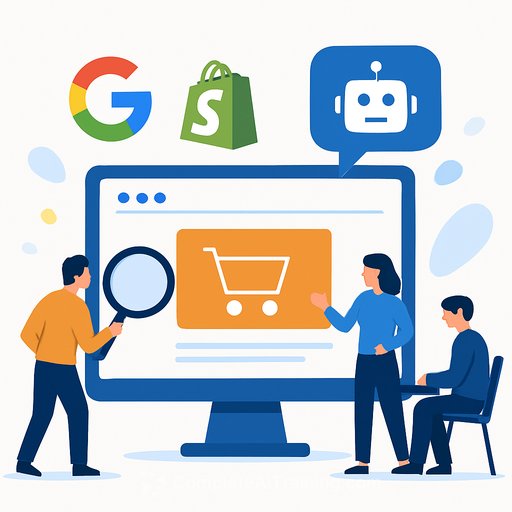
Google announced the Universal Commerce Protocol (UCP) in January, developed with Walmart and Shopify. The standard lets AI agents understand product information consistently across different retailers, reducing errors like suggesting out-of-stock items.
UCP integrates into Google Search's AI Mode and the Gemini app. Shoppers can move from discovery to purchase without leaving the platform, using payment information already stored in Google Wallet.
Salesforce has already integrated UCP into its Agentforce Commerce platform. Google also launched Business Agent, which lets retailers create branded AI agents that answer customer questions like a sales associate would.
Ashish Gupta, VP and GM of merchant shopping at Google, said the technology only works if it includes retailers of all sizes. "For this new agentic era to be really and truly successful, it has to work for everyone," he said.
Brands need to feed agents detailed product information. Google is rolling out new data attributes in its Merchant Center so retailers can upload richer product descriptions, including common customer questions and compatible accessories.
Booking Holdings, which operates Booking.com and OpenTable, is connecting its agents to property data to answer highly specific queries. A shopper asking "Is the restaurant in Milan dog-friendly?" represents the kind of niche question agents can now handle.
Shopify launched Agentic Storefronts in December, letting merchants list products on AI platforms like Perplexity and ChatGPT. Amanda Engelman, Shopify's director of product for merchant marketing, said the approach focuses on speed: "How do we enable people to move quicker?"
Media Buying Tests Show Promise - and Caution
Agencies are moving more slowly. WPP rolled out several agents this year, including a brand analytics tool. Butler/Till tested agentic media buying in December using AdCP, an open standard for advertising tasks.
The test campaign for beverage company Clubtails delivered more than 5x cost efficiencies, according to PubMatic CEO Rajeev Goel. Butler/Till also cut intermediary fees by over 80% and reduced CPMs on a separate campaign for Geloso Beverage Group while maintaining fraud and inventory standards.
Despite these results, adoption remains uneven. A January IAB report found that 66% of agencies surveyed are focusing on agentic AI for ad buying and campaign execution. Yet 40% listed understanding how to use it as a challenge.
Valerie Renda, AVP of business transformation at Kepler, said the agency is monitoring the space but taking a measured approach. Kepler sees varied client sentiment, with those in regulated industries like finance and healthcare showing more hesitation.
"When it comes to agentic AI, we need to have ownership, we need to have accuracy, and we need to have accountability for anything that AI or agents are producing," Renda said. "In order to do that, we need a governance model."
Kepler established a new business transformation unit to develop that governance framework across the agency.
The Data Problem
Agentic systems depend on quality information. Large language models consume Reddit posts, product reviews, and brand websites to decide what to show users. If that data is incomplete or inaccurate, agents fail.
Chuck Gahun, Forrester principal analyst, said brands are responding by publishing more detailed product content across multiple channels. "They're going after the content everywhere to make sure it's holistic, so that wherever Google's LLM or OpenAI's LLM is learning from, it's accurate and comprehensive," he said.
This shift means marketing teams need to think beyond their own websites. Product information now feeds algorithms that decide visibility across search, shopping platforms, and chat interfaces.
For marketing professionals, understanding AI for Marketing and AI Agents & Automation is becoming essential as these tools move from pilot projects into standard practice.
Your membership also unlocks: