Agentic AI in airports: from assistive tools to autonomous orchestrators
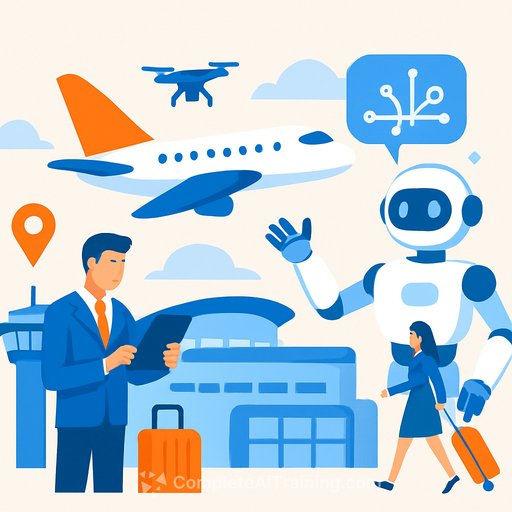
Airports are shifting from AI as a helpful dashboard to AI that executes. In 2026, agent-based systems are moving decisions and actions forward without waiting for humans to connect the dots. That matters in an environment where a single turnaround spans 100+ tasks across dozens of organisations.
The target is simple: fewer delays, smoother passenger flow, stronger yield. The method is clear: let agents simulate, decide and act within guardrails, then escalate only what truly needs human judgment.
From reactive dashboards to autonomous decisioning
Inside the APOC, agentic AI acts like an operational co-pilot. It runs constant what-if simulations, recommends gate swaps, adjusts stand sequences and reorders priorities when disruption hits. Traditional tools surface alerts; agents kick off the fix before patterns are obvious to a human.
Practical examples are already in play. When a passenger drops a bag, an airline can be alerted and see whether that passenger will reach the gate before closeout. Agents share the bag's last known location and trigger a proactive message if it misses the flight-apology included, with a clear reunification plan-so the passenger doesn't queue at lost & found.
Agentic commerce: capturing the "exhale moment"
Commercial teams are seeing AI agents turn idle time into revenue. By reading real-time intent, agents surface relevant dining and retail options right after security, when stress drops and purchase intent rises. With payment flows from providers like OpenAI, Stripe and PayPal, passengers can order food, book lounges and check out through AI-driven interfaces with minimal friction.
The operational upside: fewer lines, higher conversion, more balanced demand across concessions. The commercial upside: increased non-aeronautical revenue without adding physical space.
Virtual expansion without new terminals
Agentic systems coordinate people, bags and aircraft with precision, effectively creating capacity without concrete. Many hubs are aiming for a 10-15% lift in effective throughput using their current footprint. That's meaningful in a margin-thin environment where billion-pound builds rarely pencil out.
Agents take on the cognitive load-millions of signals per day-so your teams can focus on exceptions, safety and service. This also helps blunt the impact of persistent staffing gaps in ground handling and security.
HI + AI: augment the workforce, don't sideline it
AI isn't replacing people. Employees who use AI will replace those who don't. Two workforce priorities are paying off fast.
- Prompt engineering: Upskill frontline and APOC staff to task, query and govern autonomous agents effectively.
- Knowledge transfer: Use AI as an onboarding accelerator to give new hires instant access to institutional know-how-turning "four days of experience into four years."
If your teams need a starting point, see our Prompt Engineering resources.
The prerequisite: a shared event language
Autonomy fails without clean, interoperable data. The industry is moving toward a minimum shared event language so airports, airlines and handlers can coordinate in real time. Focus on high-value readiness events ("fuelling complete") and exception events ("baggage failure") that actually change the plan.
For a standards starting point, review IATA's AIDX messaging for operational data exchange here.
What's blocking progress
Data still trickles instead of flows. Many airports don't have final passenger and bag counts for an inbound flight even when that information exists elsewhere. Reluctance to share data-and unclear ownership models-holds back seamless coordination.
The path forward is secure data-sharing frameworks where stakeholders keep ownership while exposing time-sensitive signals. Start with the minimum viable set that drives operational decisions, then expand.
How operations leaders can move now
- Pick high-value use cases: Disruption recovery, turnaround coordination, baggage exceptions and passenger flow optimisation are proven starting points.
- Stand up a minimum architecture: Real-time data feeds, an event bus, open APIs to airline/handler systems, an observability stack and role-based guardrails - and align governance and architecture with enterprise practice (see the AI Learning Path for CIOs).
- Define human-in-the-loop rules: When can an agent act autonomously? When must it escalate? Include an abort switch, audit trails and post-action reviews.
- Run a 90-day pilot: Set clear KPIs (OTP, turnaround minutes saved, misconnects avoided, mishandled bags, retail conversion). Hold weekly ops reviews and adjust agent policies quickly - and use playbooks for pilot design (see the AI Learning Path for Project Managers).
- Lock in data contracts: Agree on event semantics, SLAs and access scopes with airlines and handlers. Start with readiness and exception events.
- Train your people: Build prompt playbooks for common tasks. Use AI co-pilots to compress onboarding time and spread best practices.
- Manage risk explicitly: Use the NIST AI Risk Management Framework as a reference for safety cases, bias checks and monitoring here.
Event: practical insights for your next quarter
International Airport Review will host a breakfast briefing at Passenger Terminal Expo on 18 March 2026, 07:30 GMT, at Crowne Plaza London Docklands by IHG. The session-"The agentic AI revolution: Architecting the future of operations, resilience, and passenger experience"-will cover minimum deployment architecture, observability and human-in-the-loop controls, safety cases, and how to run a 90-day pilot tied to disruption recovery, turnarounds, baggage and flow optimisation. Register to attend.
Bottom line
Agentic AI is moving from proof-of-concept to the operating layer of the airport. Early adopters are reporting faster decisions, fewer manual handoffs and a better passenger experience. If you lead operations, the window to test, learn and scale is this year-not next.
Your membership also unlocks: