
AI news ·
Agentic AI turns financial systems into weapons of irregular warfare
AI systems operating without human oversight are giving adversaries new ways to attack financial markets at machine speed. In March 2025, Western banks detected algorithmic trading anomalies tied to manipulated data inputs.
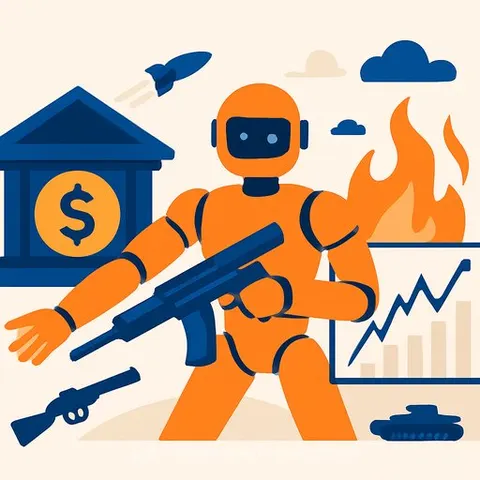
Autonomous AI Systems Now Pose Direct Threat to Financial Markets
Agentic artificial intelligence capable of operating independently at machine speed has created new vulnerabilities in financial systems that adversaries are already beginning to exploit. The threat extends beyond traditional cybercrime to include coordinated campaigns designed to destabilize markets, manipulate prices, and undermine confidence in financial institutions.
In March 2025, multiple Western financial institutions detected algorithmic trading events suggesting that adversarial attacks had altered data inputs and market signals. The details remain confidential, but the episode demonstrated that efforts to degrade financial models now constitute a form of financial warfare.
How Autonomous Attacks Work
A single imperceptible alteration to data can fool trading models in both transparent and opaque settings. Adversaries do not need to block trades or increase costs. Instead, they engineer what amounts to cognitive friction-forcing AI systems to doubt their own models and fall back on slower, manual controls.
These AI-enabled financial operations, or AIFOs, are irregular warfare campaigns conducted through weaponized finance at digital speed. They use indirect and often untraceable financial means: destabilizing capital flows, strengthening ransomware networks, and poisoning the data that trains financial models.
Unlike earlier cyber-enabled financial crime, which involved individual hacks or thefts, AIFOs are ongoing, adaptable campaigns that include market manipulation, payment disruptions, and coordinated disinformation. They operate in reflexive loops-adversarial systems generate the very market signals they later exploit.
State and Criminal Actors Are Building Capability
China has made clear in its military doctrine that financial warfare is "just as terribly destructive as bloody war." Chinese firms are pursuing foreign data under seemingly benign pretexts, often presenting themselves as AI startups or research partners seeking access to sensitive financial datasets for training purposes.
The Federal Bureau of Investigation has warned that research partnerships with Chinese firms can expose companies to PRC laws requiring data storage in China and submission to government surveillance. Chinese authorities could use such access to train autonomous AI systems capable of identifying vulnerabilities in payment systems and bypassing compliance checks.
Russia has integrated illicit finance into hybrid warfare. Since 2015, Kremlin-linked ransomware groups have extracted hundreds of millions of dollars from Western companies. These proceeds flow into shadow networks that fund state-aligned campaigns. The FBI's Internet Crime Complaint Center attributed $893 million in losses to AI-enabled schemes in recent years-a figure the FBI says understates true exposure.
North Korea depends on illicit financial activities for national survival. In 2025, North Korea-linked hackers stole over $2 billion in cryptocurrency assets, the largest annual total on record. The Lazarus Group, a state-sponsored enterprise, has appropriated billions in digital assets and demonstrated technical sophistication. With autonomous AI, such operations can scale further, generating portfolios of synthetic identities to bypass regulatory checks and timing asset liquidation with disinformation campaigns to maximize market impact.
The Cascade Risk
Financial harm from these operations can produce effects comparable to physical attack. Firms fail, jobs vanish, pension values collapse, and public confidence in institutions can be irreparably damaged. These consequences are often more diffuse than those from kinetic warfare, yet the stakes are equally severe.
Consider a hybrid scenario: China exfiltrates satellite data on agricultural yields and uses it to front-run commodity trades in US and allied markets. Simultaneously, Russia targets Western communication satellites with cyber or kinetic attacks, temporarily disrupting retail banking networks. Misinformation about data accuracy fuels market volatility while consumers face payment outages. Adversaries then ransom access to critical datasets or exploit the instability for profit.
On June 4, the United Kingdom's top banking regulator expressed deepening concern about major vulnerabilities in lenders' technology systems and worsening geopolitical tensions. Both adversary intent and capabilities are accelerating.
Building Defensive Capability
Traditional financial defenses-compliance regulations, suspicious activity reports, and supervisory reviews-operate too slowly to counter autonomous attacks. A counter-AIFO doctrine must incorporate adaptive defenses that operate at machine speed.
Defensive systems should include technical controls such as provenance verification, where defenders can perform know-your-model checks similar to customer verification protocols; cryptographic attestation linking models to specific hardware and training datasets; and "canary orders" designed to provoke telltale responses from adversarial systems.
The United States and allies should establish a Financial AI Fusion Cell drawing on the Treasury's Office of Foreign Assets Control, Office of Intelligence and Analysis, the Department of Defense's Chief Digital and Artificial Intelligence Office, and the FBI's Cyber and Counterintelligence Divisions. The Securities and Exchange Commission, Commodity Futures Trading Commission, and Federal Reserve should serve as standing observers. These nodes should partner with counterparts in the United Kingdom, Australia, and NATO, sharing model data and real-time intelligence under pre-agreed escalation thresholds.
Financial professionals should understand that AI-enabled operations represent a natural extension of irregular warfare, targeting systemic vulnerabilities rather than discrete targets. The threat is neither distant nor theoretical. Organizations should assess their data pipelines, model provenance, and coordination with regulators now.