Science: The 'Aha!' AI Moment Feels Great. Here's What It's Doing to Your Brain
A flash of insight from a chatbot can feel like the lights turning on. A new angle. A cleaner framing. A quicker path to "I get it."
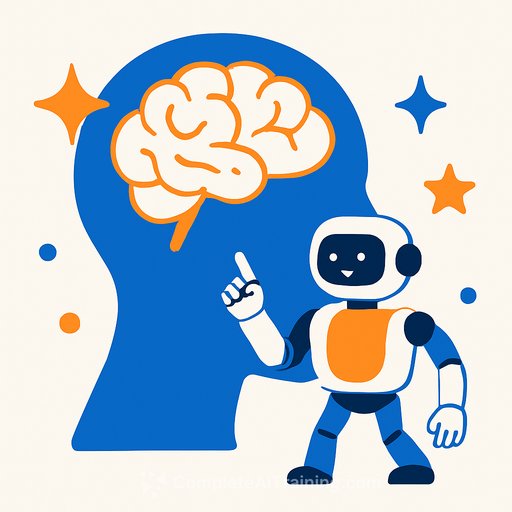
That spark has a name: the Cognitive Corridor. It's the brief window where AI throws light just beyond your mental headlights. Useful, yes. But researchers warn that living inside that glow too long can dull the very systems we rely on to think, recall, and learn.
The Cognitive Corridor: A gift, not a habitat
Picture driving at night. Your beams cover the road you know. Then a bright sweep reveals something just outside your view. That flash is what AI delivers-a suggestion you didn't consider, a comparison that reorients your question, a scaffold for the next step.
Futurist John Nosta calls this the Cognitive Corridor. His point is simple: take the light with you and keep driving. Don't set up camp in it. If you skip the messy parts-sorting ambiguity, testing assumptions, making mistakes-you outsource the very friction that builds expertise.
What recent data suggests
Early findings are sobering. In a recent MIT study, participants were split into three groups to write essays: brain-only, traditional search, and AI-assisted. The brain-only group showed the strongest neural connectivity. The AI group showed the weakest. When that AI group wrote a second essay without tools, engagement stayed low and recall dropped.
Translation: smoother inputs can lead to cognitive offloading. Less effort, less retention. Over time, weaker learning "muscles."
The shift in behavior is already visible. An Adobe survey found roughly one in four respondents prefers ChatGPT over Google. Many who stay with Google still read AI-generated summaries. That means pre-assembled ideas are becoming the default intake for many readers-often without a conscious choice.
Why easy answers blunt learning
Deep learning likes friction. Effortful retrieval, generation before feedback, and spaced reinforcement build durable memory and judgment. If AI smooths every step, your brain stops showing up. You get output without the internal upgrade.
The risk isn't using AI. The risk is skipping the steps that wire the concept into your head. Convenience can become dependence, and dependence reduces capacity.
A practical protocol for scientists and researchers
Researchers and data scientists can pair these habits with structured curricula such as AI Learning Path for Data Scientists to build disciplined thinking and reproducible workflows.
- Set your intent first. Write the hypothesis, criteria, or outline before opening a model. Create an anchor you can compare against AI output.
- Generate, then consult. Produce your first pass (ideas, methods, code, or abstracts) from scratch. Then use AI to stress-test, not to start.
- Force desirable difficulty. Time-box "no-AI" sprints (30-90 minutes) for core thinking. Bring AI in only for targeted tasks after you've wrestled with the problem.
- Use Socratic prompts. Ask the model to ask you questions. Require it to list assumptions and unknowns before giving answers.
- Demand variance. Sample multiple independent outputs (different seeds or prompts). Compare, reconcile, and document why you kept or dropped ideas.
- Teach-back to cement memory. After using AI, write a short explanation to a junior colleague-or record a two-minute voice note-without looking at the output.
- Cite and verify. Require sources with quotes or line refs. Spot-check against primary literature. No source, no claim.
- Audit your usage. Track: percent of work started vs finished with AI, number of sources verified, and time spent in no-AI sprints. Watch the trend, not the vibe.
- Keep a friction buffer. Do notes by hand for key papers or models. The slowdown helps encode and connect ideas.
Team guardrails that actually work
These guardrails align with established AI Research practices emphasizing replication, auditability, and explicit documentation.
- Define the "no-AI zone." Core reasoning, hypothesis formation, and interpretation of results start offline. AI enters after a first pass.
- Model cards for prompts. Save prompts and prompts-with-rationale in version control. Treat them like code: diff, review, iterate.
- Replication first. Any AI-assisted method write-up must include an independent reproduction step by a colleague without the original prompt thread.
- Red team your outputs. Assign someone to attack methods, stats choices, and citations. Prefer falsification over polish.
- Instrument the workflow. Log when AI is used, for what, and with which datasets or libraries. This makes later audits and meta-analyses possible.
Where AI helps vs where you need raw thinking
- Use AI for: literature triage, code scaffolds, unit test generation, outline alternatives, statistical checks, dataset documentation drafts.
- Go human-first for: research questions, causal reasoning, study design trade-offs, interpretation, limitations, and final claims.
Signals you're over-relying on AI
- You can't reproduce an argument without the thread open.
- Your notes copy phrasing from outputs instead of translating ideas in your own words.
- Recall drops 24-48 hours after "finishing" a task.
- You feel faster but can't explain the why behind key choices.
Make AI a lens, not a crutch
The Cognitive Corridor is useful. It reveals what you missed and speeds iteration. But if every pass goes through a model, your internal model stops improving.
Use AI to light the path, then turn it off and walk. The goal isn't prettier output. It's stronger neurons, cleaner judgment, and results you can defend without a browser tab.
Want structured practice using AI without losing the thinking reps? Try prompt frameworks and exercises that force depth over shortcuts: Prompt Engineering resources.
Your membership also unlocks: