
AI news ·
AI accelerates quantum computing timeline, pushing crypto to rethink encryption
AI is accelerating quantum computing development, shrinking the timeline for when current encryption could break. Blockchain networks and security teams are racing to adopt post-quantum cryptography before that window closes.
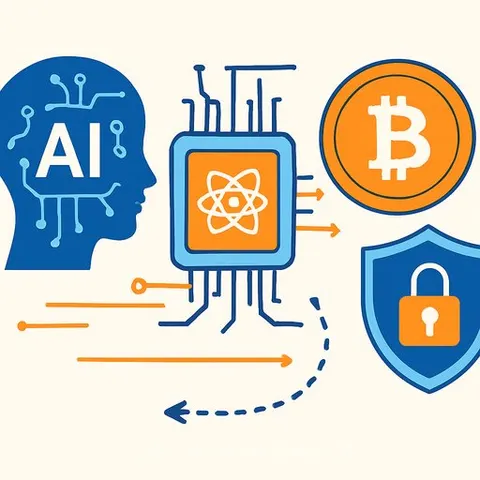
AI Is Compressing the Quantum Timeline for Crypto Security
Artificial intelligence is accelerating quantum computing development, forcing the crypto industry and broader internet infrastructure to rethink encryption defenses sooner than expected. Researchers and security builders now treat the convergence of AI and quantum as an urgent threat rather than a distant concern.
The problem is concrete: machine learning systems are already optimizing quantum error correction, one of the field's biggest engineering obstacles. AI researchers at major tech firms have been using these systems for years to discover new materials and accelerate scientific progress. That same acceleration is now compressing quantum computing timelines.
"AI is definitely being used to accelerate the development of quantum computing," said Alex Pruden, CEO of Project Eleven, which focuses on quantum-resistant infrastructure for crypto. The convergence means security assumptions that held for decades may no longer apply.
The "Harvest Now, Decrypt Later" Problem
Governments and sophisticated actors are already collecting encrypted internet traffic today, betting that quantum computers will eventually decrypt it. This strategy, known as "harvest now, decrypt later," means sensitive data transmitted today could be compromised in a few years.
"If I know quantum computers are coming in a couple of years, I will start trying to capture all possible data that's going around," said Illia Polosukhin, co-founder of NEAR Protocol and former Google AI researcher. "Everything we're putting on the internet, if you're identifiable as a person of interest, you can assume will be decrypted in two years."
For blockchain networks, the threat is especially acute. Bitcoin, Ethereum, and other systems rely on elliptic curve cryptography-the same standard used across the internet. A sufficiently powerful quantum computer could derive private keys from public keys, compromising wallets and systems.
AI as Weapon and Defense
The real challenge is that AI cuts both ways. Machine learning models are becoming increasingly effective at identifying software vulnerabilities and breaking cryptographic implementations. "I would expect the advent of AI to accelerate even more hacks," Pruden said.
Developers are deploying AI defensively too. Security teams now use AI for code auditing, testing, and formal verification-mathematical techniques that prove software behaves as intended. "AI can help with formal verification of post-quantum systems," Pruden said, which theoretically makes them more secure.
The result is a permanent arms race where neither attackers nor defenders can afford to stand still.
Post-Quantum Migration Has Started
Several major blockchain networks are already moving. Ethereum, Zcash, Solana, Ripple, and NEAR are actively researching or implementing post-quantum migration strategies.
NEAR recently announced plans to integrate post-quantum cryptography directly into its account infrastructure. This allows users to rotate cryptographic schemes without migrating assets to entirely new wallets. "Back in 2018, when we were designing NEAR, we were like: 'Hey, quantum will come, we should have an easy way to do it,'" Polosukhin said.
The technical barrier remains significant. Post-quantum cryptographic systems are often substantially larger and slower than current standards. "The cryptography that's currently standardized for post-quantum is very big and slow," Polosukhin said.
Security Becomes Continuous, Not Static
The broader implication undermines a foundational assumption of the digital age: that encryption remains reliable for long periods. That assumption no longer holds.
"Nothing is going to be as static as it's been in the future," Pruden said. "Either a quantum computer comes online to break some fundamental assumption, or AI gets smart enough to break that assumption too."
For IT and development teams, this means security can no longer be treated as infrastructure upgraded once per decade. Systems must now continuously adapt. The question is no longer whether to prepare for post-quantum cryptography, but how quickly your organization can implement it.
Developers working on security-critical systems should start evaluating post-quantum options now. The window for gradual migration is narrowing. AI Learning Path for Cybersecurity Analysts covers the intersection of AI threat detection and cryptographic defense-skills increasingly essential for this transition.