AI Tackles Complex Equations, Driving Faster Advances in Drug and Material Design
Solving complex scientific problems often demands years of dedicated effort. Artificial intelligence (AI) is cutting that time dramatically, enabling breakthroughs at a much faster pace. Dr. Shuiwang Ji, professor in the Department of Computer Science and Engineering at Texas A&M University, leads efforts in the emerging field of AI for science and engineering (AI4Science), focusing on accelerating problem solving across scientific disciplines.
Recently, Dr. Ji and colleagues from 15 universities collaborated on an extensive paper published in Foundations and Trends in Machine Learning. This work, spanning over 500 pages and involving more than 60 authors, details how AI can assist in solving notoriously difficult equations that underpin many scientific models.
Breaking Down the Challenge
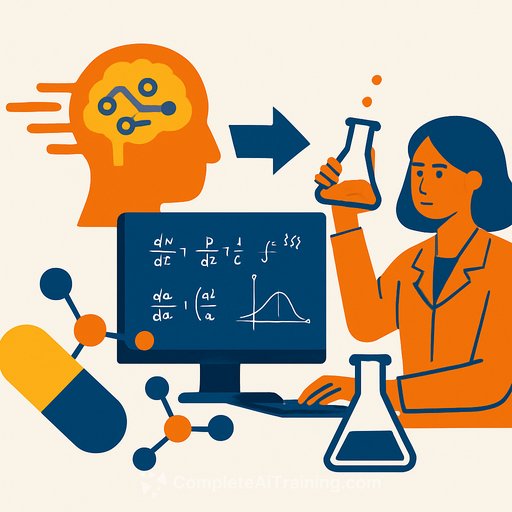
Natural sciences aim to explain phenomena across quantum, atomic, and continuum scales. Each scale is governed by differential equations that become increasingly complex as the system size increases. For example, Schrödinger’s equation accurately models quantum behavior on a small scale—such as interactions between two electrons—but becomes exponentially difficult to solve as more particles are involved.
Traditional methods quickly reach their limits when addressing large-scale systems. Here, AI offers a practical solution by efficiently approximating solutions to these equations, enabling analysis that was previously out of reach.
Applications Across Science and Engineering
Using AI to solve differential equations accelerates research in areas such as:
- Drug discovery
- Material design
- Battery materials
- Catalyst development
By reducing computation times from years to much shorter periods, AI empowers researchers to iterate faster and explore complex systems with higher accuracy.
Collaborative Research and Future Directions
Dr. Ji directs Texas A&M’s Research in Artificial Intelligence for Science and Engineering (RAISE) Initiative, which involves over 85 faculty members dedicated to advancing AI-driven scientific research. The initiative fosters collaboration to push the boundaries of what AI can achieve in scientific contexts.
"Our goal is to use AI to deepen scientific insight and improve engineering design," said Dr. Ji. His focus on fundamental science stems from the shared principles and governing equations that connect multiple disciplines.
Learn More
The full paper, Artificial Intelligence for Science in Quantum, Atomistic, and Continuum Systems, offers a comprehensive overview of AI applications in scientific problem solving.
For professionals interested in expanding their AI skills in scientific contexts, explore relevant courses at Complete AI Training.
Your membership also unlocks: