
AI news ·
AI adoption drives middle management cuts and lowers employee engagement
Amazon cut 14,000 middle managers as AI automates routine tasks. Meanwhile, job postings requiring AI fluency have grown sevenfold.
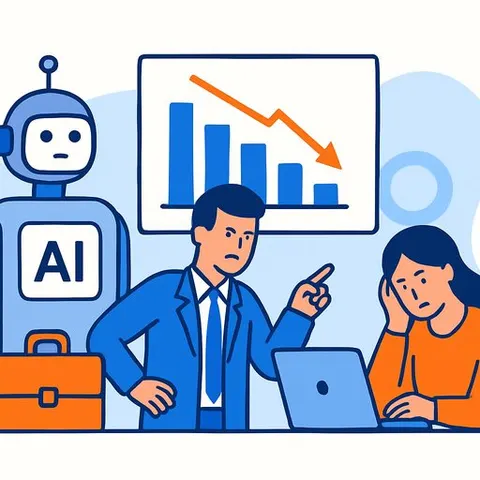
Amazon laid off 14,000 middle managers last year, a stark signal that companies are using AI to justify cutting a layer of management that once seemed indispensable. While the pace of organizational flattening has slowed in 2026, the pressure on middle managers is not letting up. Their daily tasks-chasing teams for data, relaying information from senior leadership, tracking progress-are increasingly handled by AI systems that work faster and cost less.
The Human Cost of AI Adoption
Dr. Shannon Franklin, a licensed psychologist specializing in workplace wellbeing, argues that middle managers have always performed a critical function that never appears in job descriptions. "Middle managers are typically in a position to interpret the emotions related to organizational change for their employees," Franklin told Newsweek. "They provide clarity regarding changes that employees don't understand, allow issues to be addressed before becoming major problems, and can establish an 'us' mentality that is difficult for technology to duplicate."
Strip away that layer, and the way employees show up at work changes. Franklin pointed to a subtle warning sign that often precedes a spike in turnover. "One of the first indicators that things are going wrong isn't typically a high rate of employee turnover," she said. "It's when employees stop talking. They're asking fewer questions, they're sharing fewer concerns with their colleagues and supervisors, they're becoming very careful to bring up ideas or question managerial decision-making."
When open dialogue fades, trust erodes. Franklin cautioned that companies might mistake short-term efficiency gains for a healthy workplace. "While they might experience small improvements in efficiencies, their overall employee engagement and ability to respond to adversity will likely decrease," she added.
Will Middle Management Make a Comeback?
A McKinsey report from November 2025 found that demand for AI fluency-the ability to use and manage AI tools-grew sevenfold in job postings between 2023 and 2025, outpacing all other skills. This shift suggests that the role of middle management is not disappearing, but transforming. Jeff Burnstein, president of the Association for Advancing Automation, believes that the people who succeed will blend business acumen with technical oversight. "The people who thrive will translate business needs into technology decisions, coach teams through change, and use AI to make better operational decisions," he told Newsweek. "In 10 years, there may be fewer people whose only job is managing processes, but there will be a greater need for people who can manage work, technology and people."
As companies increasingly demand AI fluency from their managers, professionals are turning to AI for Managers Courses to build the skills needed to lead in this new environment. Executives, meanwhile, are rethinking organizational structures and strategy, often seeking out AI for Executives & Strategy resources to manage the organizational flattening without losing institutional knowledge.
Why This Matters for Managers
The squeeze on middle management is not a temporary blip. It reflects a structural shift in how companies value the coordination, interpretation, and emotional labor that managers provide. The managers who remain will be those who can use AI to enhance their decisions, not just monitor tasks. Building AI fluency is no longer optional-it is the skill that will separate the roles that survive from those that get automated away.