AI in Project Delivery: Adoption Doubled - What Managers Should Do Next
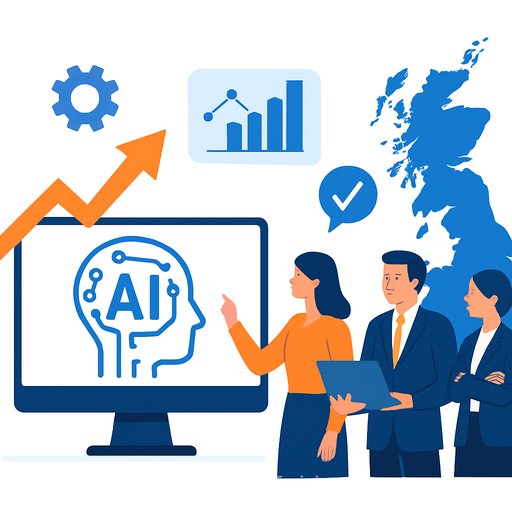
AI use in UK projects has jumped from 36% in 2023 to 70% in 2025, according to the Association for Project Management (APM). That surge signals a practical shift: teams are moving from experiments to daily use that saves time, tightens forecasts and trims risk.
The momentum is real, but so are the gaps. Many teams still lack training, fit-for-purpose governance and confidence in the outputs. Your job is to convert interest into consistent, safe performance.
The numbers that matter
APM's new research report, "Integration of AI with Agile Project Management in the Context of Sustainability," captures the step-change. The work highlights insights from Dr Ruben Burga and Professor Chris Spraakman of Mohawk College.
- Adoption: 36% (2023) to 70% (2025)
- "Very positive" sector outlook: 15% (2023) to 62% (2025)
- By industry: Construction 15% → 75%, Financial Services 23% → 66%, Engineering 35% → 73%, Transport 36% → 71%
APM research aligns with what many leaders are seeing on the ground: AI is moving from talk to tooling.
Why adoption is accelerating
- Clear wins: Faster reporting, leaner schedules, better risk visibility.
- Accessibility: Generative tools, predictive analytics and agents are easier to deploy.
- Competitive pressure: Digital strategies now expect AI inside core workflows.
As familiarity grows and quick wins stack up, confidence spreads across portfolios and functions.
Where AI is paying off right now
- Task and schedule automation (updates, dependencies, reminders)
- Resource planning and allocation
- Reporting and dashboarding (status, KPIs, variance)
- Risk analysis and issue scanning
- Stakeholder communications (summaries, action logs, meeting notes)
Tools that handle the admin let your team shift attention to delivery, decisions and alignment.
Barriers you need to clear
- Skills and training: Nearly half of current users report capability gaps.
- Trust and accuracy: Output quality varies; teams need verification routines.
- Security and privacy: Data handling and access controls are inconsistent.
- Integration: Point tools aren't always connected to project source systems.
Build trust and readiness (fast)
- Create psychological safety: Make experimentation part of the plan, not a risk to careers.
- Be transparent: Explain tool boundaries, data sources and validation steps.
- Govern data: Define what can be shared, logged and retained. Minimise sensitive inputs.
- Train for safe use: Go beyond "how to click" and cover ethics, privacy and error handling.
- Show value with familiar processes: Start with reporting, minutes, RAID logs and forecasting.
The next phase: from automation to strategic partner
Expect AI to move deeper into scenario analysis, forecasting and risk/opportunity sensing. Agents will surface options, simulate outcomes and recommend next steps that fit the project's context.
In large agile programmes, AI can streamline data flows, highlight patterns and bring real-time insight to prioritisation. This isn't replacement. It's leverage-more time for leadership, alignment and decisions that matter.
90-day execution plan for managers
- Days 1-30: Pick 3 use cases with clear ROI: status reports, meeting notes, risk scanning. Set data rules. Choose tools that integrate with your PM stack.
- Days 31-60: Pilot with one project per function. Define acceptance criteria (accuracy, time saved). Add human-in-the-loop checks.
- Days 61-90: Scale to a programme. Build playbooks, templates and checklists. Track cycle time, forecast accuracy and issue lead time.
Guardrails you should have in place
- Access control and audit trails for any AI tool touching project data
- Red-team prompts for bias, hallucinations and leakage risks
- Human approval for decisions with cost, compliance or safety impact
- Vendor assessments: data residency, retention, model updates, incident response
- Alignment with recognised frameworks (e.g., NIST AI RMF)
Team skills that matter now
- Prompting for structure: ask for formats your PMO can use (RAG status, RAID tables, decision logs)
- Verification: cross-check outputs against source systems and baselines
- Data discipline: classify inputs, strip sensitive fields, document sources
- Change adoption: teach the workflow, not just the tool
If your organisation needs a structured path to upskill by role, explore curated options here: AI courses by job.
What this means for you
The gap is no longer technology. It's operating model, trust and skills. Close those, and AI becomes a quiet force multiplier across delivery, not a side project.
As Burga and Spraakman put it, the winners integrate AI as an enabler of human-centred project management-stronger morale, sharper thinking and sustained productivity. That's the bar.
Your membership also unlocks: