
AI news ·
AI agents become scientific collaborators to manage research workflows and analyze data
AI agents now automate literature reviews by scanning over two million annual papers. This frees scientists to focus on data analysis.
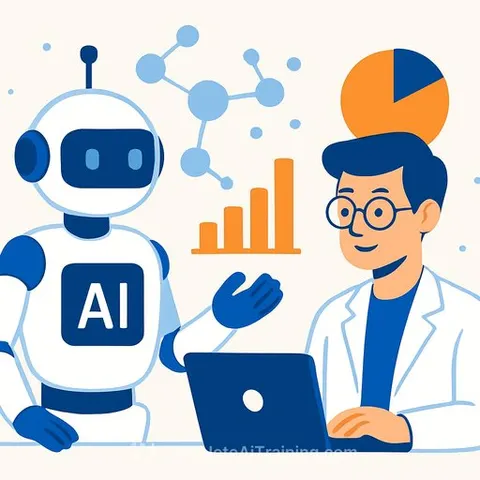
More than two million scientific papers are published annually, and the datasets behind modern research have grown beyond any single researcher's capacity to process them. AI agents are emerging as collaborators that can compress months of literature review into hours, coordinate complex multi-step workflows, and surface connections across disciplines that human scientists would likely miss. The shift from single-task AI tools to agentic systems that orchestrate entire research pipelines is changing how scientific organizations approach discovery-not by replacing scientists, but by handling the tedious coordination work that consumes their time.
From AI tools to AI research collaborators
An AI tool performs one specific task when asked. An AI agent, by contrast, executes a series of coordinated tasks and adjusts when something fails to produce the desired outcome. It also connects the output of one task to provide the input necessary for the next. This distinction matters because science is a chain of decisions, not a collection of isolated actions.
Research organizations have increasingly invested in AI for Science & Research systems capable of managing entire scientific workflows-coordinating literature reviews, planning experiments, synthesizing findings, and integrating external databases. These agentic systems now orchestrate multi-step research activities, automating much of the coordination that researchers previously handled manually.
Accelerating literature review and hypothesis generation
One of the biggest bottlenecks in research is discovering what work has already been done. As publications multiply exponentially across fields, even narrow sub-specialties produce more papers than any individual can track. The problem compounds when research crosses disciplinary boundaries, where no single expert holds all the relevant knowledge.
AI agents address this by using semantic search and evidence synthesis techniques to scan millions of publications, map citation relationships, and identify conflicting results across studies. They surface connections between disciplines that researchers would typically miss. This gives scientists a clearer picture of the knowledge landscape before a project begins, reducing the likelihood of pursuing dead ends and revealing gaps that haven't yet been explored.
The same capability extends to generating hypotheses. Humans simply cannot process thousands of studies and datasets simultaneously to spot non-obvious connections. AI agents can flag knowledge gaps and suggest new research directions based on how disciplines intersect. As the technology identifies patterns across fields, it surfaces questions that might otherwise go unasked-giving researchers more opportunities to explore without diminishing their creativity.
Coordinating workflows and interpreting complex data
Modern research projects consist of interconnected activities rather than standalone experiments: designing protocols, organizing computational tasks, managing datasets, scheduling simulations, documenting progress, and adapting plans when results diverge from expectations. Researchers have traditionally struggled to coordinate these moving parts across a project's lifespan.
AI agents are positioned to handle pipeline coordination by tracking dependencies and adjusting as the project evolves. Multi-step workflows that once required dedicated teams can now be managed by agentic systems. At the same time, laboratories produce overwhelming volumes of multimodal data-from genomics, medical imaging, materials characterization, and climate modeling-that researchers can no longer analyze manually. AI agents process these datasets, analyze simulation output, perform image analysis, and flag anomalies that warrant human attention. This shifts researcher time from raw data processing toward interpretation, judgment, and deciding what to investigate next.
Why human scientists remain essential
Curiosity, skepticism, creativity, and ethical judgment are fundamental to scientific discovery, and AI agents cannot supply these on their own. Validation and reproducibility of results remain non-negotiable requirements that demand human accountability. Peer review exists precisely because reviewers must understand not only what data was produced, but the assumptions and limitations embedded in the methods used.
Deciding which problems matter and what the answers mean stays entirely within human scope. AI agents function as scientific collaborators, not scientific directors. They accelerate the mechanical parts of research so scientists can focus on insight and judgment.
Why this matters for science and research professionals
Organizations that begin investing now in AI-powered research capabilities will conduct research faster and ask better questions while retaining the value of human researchers. For individual scientists and research teams, the practical takeaway is clear: AI agents are becoming long-term collaborators across the entire arc of research, from idea generation to prototype creation. Interdisciplinary discovery stands to benefit most, as AI agents connect data across biology, physics, materials science, and computation-breaking down barriers that have historically slowed breakthrough work. Building practical competency in these systems through an AI Learning Path for Research Scientists can help research professionals integrate agentic tools into their existing workflows without waiting for institution-wide adoption.