AI Agents Could Transform Electron Microscopes Into Active Scientific Partners
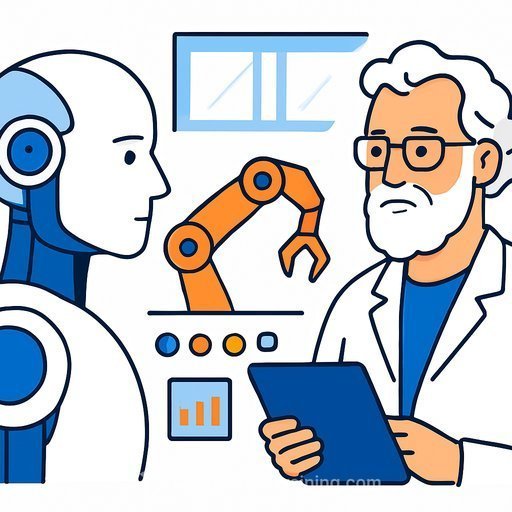
Electron microscopes have long been passive tools-instruments that acquire images for scientists to interpret. A new framework proposes turning them into thinking systems that reason about experiments, generate hypotheses, and guide discovery in real time.
The shift hinges on agentic artificial intelligence: systems where multiple specialized AI agents collaborate to solve complex problems. Unlike a single chatbot, agentic systems combine domain expertise, access to scientific literature, and computational tools. Applied to electron microscopy, they could handle tasks that currently depend on human intuition-deciding which experimental parameters to use, adapting protocols mid-experiment based on results, and spotting unexpected phenomena worth investigating.
Three roles for agentic systems
Experimental design: Before a microscopy session begins, agents specialized in physics, materials science, and instrument constraints could review published literature and prior lab results to propose optimized experimental protocols. For techniques like 4D-STEM-where probe angle, detector geometry, and beam dose are tightly linked-this could cut planning time from months to days and lower barriers for non-expert users.
Closed-loop experimentation: During in situ or operando experiments, agentic systems could continuously adjust imaging parameters in response to observations. In a liquid-phase TEM study of nanoparticle behavior, for example, agents could systematically vary electron dose, analyze how diffusion patterns change, and propose mechanistic explanations-all without human intervention between cycles.
Real-time discovery: As experiments run, co-scientist agents could contextualize observations against existing literature, detect deviations from expected behavior, and propose new hypotheses. A heating experiment showing unexpected defect migration patterns might trigger the system to suggest strain-field coupling or defect interactions as candidate mechanisms.
What agentic systems can do that current automation cannot
Modern electron microscopes already handle alignment, aberration correction, and data acquisition automatically. Machine learning has advanced image analysis. But these tools operate within fixed parameters. They don't reason across experiments, integrate knowledge from multiple disciplines, or engage with open-ended research questions-the core of scientific discovery.
Agentic systems work differently. They synthesize information across sources, adapt goals as new data arrives, and explain their reasoning. A critic agent can evaluate whether observed results match theoretical predictions and flag inconsistencies. Multiple agents can debate competing interpretations before deciding on the next experimental step.
The human role stays central
Scientists would define the research question and supervise the agentic system. They would verify outputs, check for hallucinations-errors where AI generates plausible-sounding but false information-and communicate findings to the scientific community. Humans remain responsible for experimental integrity and accuracy.
Verification layers will be essential, especially when agents control expensive hardware. Recent work shows that training agents to use external tools, providing domain knowledge through specialized agents, and implementing critic functions can reduce hallucination rates significantly.
The infrastructure gap
Realizing agentic electron microscopy requires changes beyond AI algorithms. The scientific community needs:
- Open access to publications: Agentic systems depend on reading experimental details in text, figures, and supplementary materials. Expanding open access and standardizing how parameters are reported would immediately increase usefulness to AI systems.
- Public data repositories: Structural biology succeeded partly because of centralized databases like the Protein Data Bank. Materials electron microscopy lacks comparable infrastructure. A unified repository for raw TEM data, diffraction, spectroscopy, and metadata would be essential.
- Standardized interfaces: Microscopes need secure APIs that allow software agents to interact safely with hardware controls across different facilities. Instrument manufacturers have begun shifting toward open software ecosystems and Python interfaces-a necessary step.
- Multimodal data formats: Electron microscopy produces images, videos, and spectroscopy data simultaneously. Raw data and metadata must be archived in interoperable formats so agents can reason across modalities.
- Documented failures: Scientists learn from unsuccessful experiments as much as successful ones. Yet negative results rarely appear in publications or databases. Well-documented failed attempts represent a critical resource for training agentic systems to plan, adapt, and reason like human experts. This will require new incentive structures-funding agencies and facilities could reward archiving unsuccessful experiments.
The transition to agentic electron microscopy is fundamentally a problem of infrastructure and scientific culture, not just AI capability. Closing these gaps will determine whether these systems become practical tools for discovery or remain theoretical possibilities.
Explore more about Generative AI and LLM systems, or learn how AI for Science & Research is being applied across disciplines.
Your membership also unlocks: