AI, Robots, and Clear Language: How IBS Turned a Nature Paper into Public Impact
On the 24th of last month at UNIST, three people sat down to solve a problem many labs face: how to explain complex, cross-disciplinary work to the public without losing the science. Senior researcher Yankai JIA, senior administrator Hwang Jihee, and IBS PR team administrator Lee Seungeon walked through how they translated a high-intensity automation study into a press release people would actually read.
This story also sits within a larger moment. The 6th "Science Alive 2025," held on December 11 at the IBS Science and Culture Center in Daejeon under the theme "Science Beside U," spotlights how research and daily life meet-and how AI is changing both benchwork and communication. The team here won a PR Award for the work you're about to see.
A Nature paper, a new center, and 1,000 experiments a day
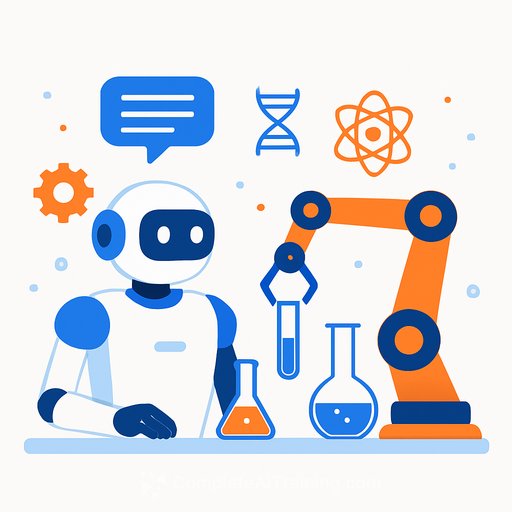
On September 25, the IBS Center for Artificial Intelligence and Robot-guided Synthesis published research in Nature describing a platform that automatically runs about 1,000 chemical experiments per day and analyzes the results with precision. JIA is the first author.
The center itself is new. Formerly the IBS Center for Soft and Living Matter, it relaunched on December 30, 2023 with a focus on AI and robotics, led by Distinguished Professor Bartosz Grzybowski at UNIST. The pivot made the team's communication challenge even sharper: advanced automation, dense chemistry, and a multilingual lab.
Solving the language barrier with AI
Most members of the center are foreign nationals, and none are fluent in Korean. JIA put it plainly: "I entered the research content in English into an AI and repeatedly asked it to translate it into easy Korean. Then we showed it to Korean colleagues and the PR team to fix awkward parts. We repeated this process."
Hwang added, "We asked the AI to explain technical terms like 'Hantzsch pyridine synthesis' in a way a middle school student could understand. We translated that back to English and kept checking with JIA." Lee noted that direct, literal translations of technical terms often read awkwardly or miss nuance, so the team focused on meaning first, wording second.
From jargon to meaning
The final press release didn't talk down to readers; it cut straight to what matters. Hantzsch pyridine synthesis was described as "a chemical reaction first reported 150 years ago, used to create various pharmaceuticals like antibiotics and anticancer drugs."
A "hyperspace map" became "a tool that organizes multiple chemical reactions into a single map to find desired outcomes." And instead of "yield" and "selectivity," the text used "how efficiently and accurately the desired substance is produced."
JIA emphasized, "The hyperspace map is a concept long used in physics, but our center was the first to apply it to chemistry. We met often with the PR team to find the best way to convey its meaning and significance."
Show, don't tell: the robot arm as the headline
When explanations stalled, the PR team went to the lab. They shot video of the automated workflow-lab, equipment, and researchers-from multiple angles. Before filming, they aligned on two questions: What best shows the core of the research? What would be most interesting to the public?
They decided to feature the robotic arm's movements and the automated process. JIA fine-tuned camera angles and prepared reagent samples with high color contrast so the video would be clear at a glance. The goal: let the visuals carry the message, then let the copy fill the gaps.
Impact beyond the paper
The outreach paid off. JIA, who has lived and researched in Korea since 2019, said he felt renewed pride in his work and in conducting it in Korea. He also received collaboration proposals from multiple institutions, including KAIST, after the coverage.
A follow-up paper is coming this year. The team plans to expand the work through collaborations across fields.
Practical playbook for labs and PR teams
- Run a bilingual loop: draft in English, simplify in Korean (or the public language), then back-translate and verify with the first author.
- Define terms by purpose: replace jargon with what the concept does and why it matters for the result.
- Use a "middle school test": if a smart 14-year-old can follow the logic, your peers will fly through it.
- Pair copy with motion: identify one process the camera can follow (here, the robotic arm) and build your story around it.
- Script verification: give researchers final pass on scientific accuracy after simplification, not before.
- Create a term bank: settle on consistent, reader-first phrases for recurring terms like yield, selectivity, and reaction classes.
- Design for color and contrast: prepare visuals that make variables obvious without captions.
- Measure outcomes: track inbound collaboration, media pickup, and follow-on citations tied to the release and video.
Context: Science beside us, not behind closed doors
"Science Beside U" isn't just an event theme-it's a working standard. AI is now part of research and communication. The IBS team showed that you don't need perfect language fluency to communicate well. You need a tight loop, clear definitions, and visuals that do half the explaining for you.
If your lab or comms team is looking to improve its prompting for tasks like simplification, translation, and outline drafting, see these practical resources on prompt engineering.
Key details at a glance
- Center: IBS Center for Artificial Intelligence and Robot-guided Synthesis (launched Dec 30, 2023; Director: Bartosz Grzybowski, UNIST)
- Paper: Automated platform performing ~1,000 chemical experiments per day (Nature)
- Lead researcher: Senior researcher Yankai JIA (first author)
- PR team: Senior administrator Hwang Jihee (center) and administrator Lee Seungeon (IBS PR Team)
- Core communication tactics: AI-assisted simplification, lab filming focused on the robotic arm, term-by-term meaning mapping
Simple system, repeatable process, meaningful reach. That's the work.
Your membership also unlocks: