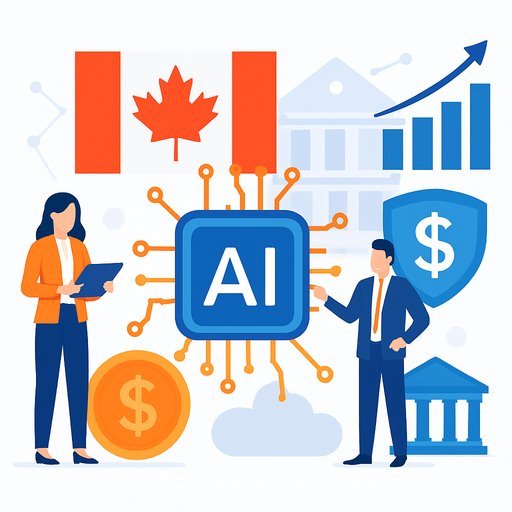
The Role of AI in Securing Insurance Data and Cloud Security for Insurance Companies
Insurance runs on trust, and trust runs on data security. As digital channels scale, carriers hold growing volumes of sensitive information-and that raises the stakes. Meeting regulations is the floor. Protecting customers and keeping systems resilient is the ceiling.
AI and cloud are central to how insurers operate today. They bring speed, flexibility, and visibility. But they also widen the attack surface. The answer is a clear security strategy that blends people, process, and technology from day one.
AI that actually improves cyber defense
Traditional tools flag what they're told to flag. AI learns how your environment behaves and spots the oddities: credential misuse at 3 a.m., sudden data exfiltration, a policy admin accessing records they've never touched before. That shifts security from reactive to predictive.
Used well, AI lowers mean time to detect and respond. Deviation-based alerts reduce noise. Automated containment-quarantining endpoints, revoking tokens, locking high-risk sessions-buys your team time.
- User and entity behavior analytics to catch account takeover and privilege creep
- AI-driven phishing detection that inspects intent, not just links
- Model-assisted triage to prioritize incidents that threaten PII and core systems
- Continuous monitoring for data integrity across policy, claims, and billing platforms
Cloud security that holds under pressure
Cloud gives insurers scale, but misconfigurations remain the fastest path to a breach. Treat security as a shared responsibility. Your provider covers the infrastructure; you secure identities, data, and configurations.
- Enforce least privilege with strong IAM, short-lived credentials, and just-in-time access
- Use CSPM and CIEM to spot open buckets, risky policies, and drift in real time
- Encrypt data at rest and in transit; manage keys outside the cloud account where feasible
- Segment networks and workloads; apply Zero Trust to internal services, not just users
- Continuously scan pipelines and containers; block vulnerable images pre-deploy
Layer your controls. Cloud-native tools handle the basics. AI-driven oversight adds context, catches subtle patterns, and speeds response.
A high-tech safeguard for policy records
Some carriers are piloting blockchain to keep policy changes tamper-evident. Think of it as an edit log that can't be quietly rewritten. It's helpful for audit trails, reinsurance reconciliations, and dispute resolution.
On the front end, stronger identity checks matter. Two-factor authentication, document verification, and camera-based liveness tests reduce fraud without adding too much friction.
Practical innovation that serves the business
AI analytics can sharpen product strategy: which segments convert, which riders drive persistency, where claims patterns hint at leakage. On the back end, blockchain-backed policy histories can improve transparency with regulators and partners.
The goal isn't technology for its own sake. It's cleaner operations, fewer blind spots, and tighter control of sensitive data.
Play by the rules-and do the right thing
Regulations keep tightening, and that's a good thing. Build compliance into your architecture and your models. Keep data collection minimal, label it clearly, and log decisions end to end.
- Use explainable AI where decisions affect customers or risk
- Run bias and drift checks; document model lineage and approvals
- Extend third-party risk reviews to AI vendors and cloud services
- Align with insurance-specific security requirements like the NAIC Insurance Data Security Model Law
- Adopt guidance such as the NIST AI Risk Management Framework for model governance
Your action plan
- Map critical data flows across policy, claims, and distribution; reduce where you can
- Deploy AI-enabled detection and response; measure MTTR and false positives monthly
- Tighten cloud identities and configurations; automate checks in CI/CD
- Enable strong customer authentication and step-up verification for high-risk actions
- Run quarterly incident simulations with business, legal, and PR at the table
- Track a short list of metrics: access anomalies resolved, misconfigurations fixed, vendor risks closed, and audit findings remediated
The bottom line
Security isn't a project. It's an operating system for your business. AI and cloud make it faster and smarter, but only if you pair them with clear guardrails and ongoing checks.
Invest ahead of the threat, prove your controls work, and make it simple for customers to trust you with their data.
If you're upskilling teams on AI, governance, and automation, explore focused learning paths at Complete AI Training.
Your membership also unlocks: