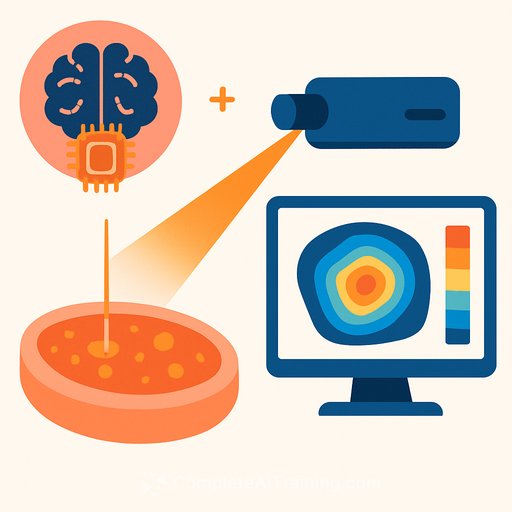
3D Temperature Mapping Inside Living Tissue Using Light and AI
A collaborative team from Ca' Foscari University of Venice and Universidad Autónoma de Madrid has introduced a new method for three-dimensional temperature mapping inside biological tissues. This approach combines invisible near-infrared light with artificial intelligence, offering a non-invasive, cost-effective alternative to traditional imaging techniques.
Riccardo Marin, associate professor at Ca' Foscari and lead author, explains, "We're turning optical distortions, usually considered a problem, into a source of information." Their technique measures not only the temperature of tissue but also its depth beneath the surface, providing detailed thermal insights.
How the Technique Works
The system uses luminescent nanothermometers composed of silver sulfide (Ag₂S) nanoparticles. When excited by light, these particles emit near-infrared fluorescence. Both the color and intensity of this glow vary depending on the particle’s temperature and the volume of biological tissue the light passes through.
To interpret these subtle spectral variations, the researchers developed a dual-layer neural network trained on hundreds of hyperspectral images captured under diverse conditions. The AI model can then reconstruct accurate 3D thermal maps, even within biologically complex environments.
Experimental Validation and Potential Applications
- Proof-of-concept tests showed the ability to detect temperature gradients in artificial tissue phantoms and real biological samples.
- The team successfully mapped blood vessels in a living animal, marking a first for remote, high-resolution 3D thermal imaging using light alone.
- Unlike conventional imaging methods such as fMRI or PET scans, this optical approach is portable, safer, and far less expensive, which could extend diagnostic capabilities beyond hospital settings.
Beyond temperature, the same principles could be adapted to measure other vital biological parameters like oxygen concentration and pH by adjusting the optical properties of the nanoparticles.
Erving Ximendes, assistant professor and Ramón y Cajal Fellow at Universidad Autónoma de Madrid, highlights the role of AI: "Machine learning offers a powerful tool for navigating the complexity of real biological systems—far beyond what traditional models can achieve."
International Collaboration and Future Directions
This project began during Marin’s tenure at Universidad Autónoma de Madrid and involved contributions from Anna Romelli, a Ca' Foscari student on Erasmus exchange. Marin recently returned to Ca' Foscari, reinforcing the university’s commitment to attracting top researchers and fostering global partnerships.
Next Steps: Probing the Cell’s Inner Environment
Building on this breakthrough, Marin leads a new five-year project funded by a €1.5 million grant. Named MAtCHLESS, the initiative will develop advanced luminescence nanosensors and imaging systems to monitor intracellular parameters such as temperature, pH, and oxygen with high speed and resolution.
The project will explore both mammalian cells and extremophile microbes, organisms adapted to extreme environments. Results may impact medical diagnostics, biotechnology, and even astrobiology by shedding light on life’s behavior in harsh conditions on Earth and possibly other planets.
For more detailed scientific information, see the publication: Luminescence-enabled three-dimensional temperature bioimaging, Nature Communications (2025).
Your membership also unlocks: