
AI news ·
AI and the Future of Justice: How India’s Legal Leaders Are Redefining Law with Technology
India’s legal leaders gathered to discuss AI’s integration in courtrooms, emphasizing ethical use and human judgment. AI aids efficiency but cannot replace justice’s human core.
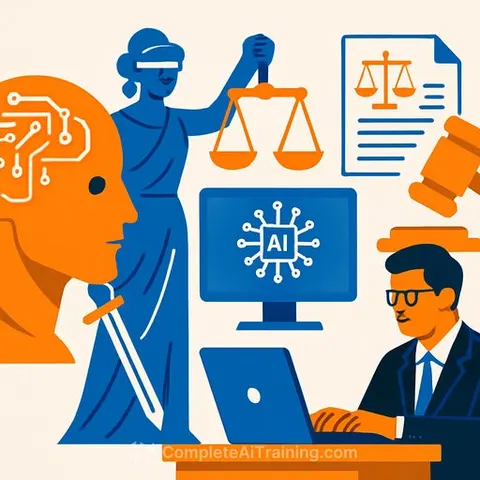
Reimagining Legal Practice with AI: A Dialogue Between the Bench and Bar
India’s leading legal experts, judges, regulators, and technologists recently convened at the event “Reimagining Legal Practice with AI: A Dialogue Between Bar and Bench – Courtroom to Conference Room: AI’s Impact on Legal Systems and Practice.” Hosted by ETLegalWorld in partnership with Microsoft India and supported by the Bombay Bar Association, this gathering marked a significant step in integrating artificial intelligence into the country’s legal framework.
Monica Behura, Editor of ETLegalWorld, opened by highlighting how AI has moved beyond theory to become an integral part of courtrooms, contracts, and legal professionals’ workflows. She stated, “AI is no longer an abstract concept; it is now embedded in our courtrooms, our contracts, and increasingly, in the conscience of legal professionals.”
Perspectives on AI and Legal Efficiency
Lalit Bhasin, President of the Society of Indian Law Firms, reflected on the evolution from typewriters to AI-driven tools. While he welcomed technological advances, he expressed concern over whether these changes have truly sped up case disposal. “We have made filing easier, but disposal still suffers. Justice must not only be accessible, it must be timely,” he noted.
Swapna Parambath, Senior Director for Legal and Regulatory at Microsoft India and South Asia, delivered the keynote address, urging the legal profession to adopt AI with ethical mindfulness. She described this phase as a “constitutional moment” and stressed that AI must be fair, accountable, and aligned with constitutional values. Parambath called for joint efforts among the judiciary, bar, academia, and civil society to develop a human-centered approach to AI integration.
Regulatory Insights and Ethical Considerations
Shri Ananth Narayan, Whole-Time Member of SEBI, discussed how technology is transforming regulatory functions. He cautioned that applying automation to inefficient systems only amplifies their problems. Highlighting SEBI’s innovations like the updated SCORES platform and the AI-enabled chatbot SAARTHI 2.0, he emphasized accountability. “If you deploy an AI tool, you remain wholly responsible for its data privacy, outputs, and legal compliance,” he said, advocating for principle-based regulation, auditability, and collaboration between regulators, law firms, and technologists.
Nitin G. Thakker, President of the Bombay Bar Association, shared a cautionary tale about over-reliance on generative AI. An intern’s use of ChatGPT to answer a complex arbitration question resulted in an incorrect legal basis, despite arriving at a seemingly correct conclusion. Thakker stressed the importance of lawyers verifying AI-generated content and safeguarding client confidentiality at all times.
Panel Discussion: Shaping AI Regulation in India
The first panel, moderated by Gauri Gokhale of Nishith Desai Associates, brought together Shardul S. Shroff (Shardul Amarchand Mangaldas & Co.), Haigreve Khaitan (Khaitan & Co.), and Anand Desai (DSK Legal) to examine India's regulatory response to AI adoption.
- Shardul S. Shroff emphasized that AI regulation should avoid a "one-size-fits-all" model, given the diverse pace and nature of AI development across sectors.
- Haigreve Khaitan highlighted ethical issues, noting clients often expect disclosure when AI tools are used and anticipate reduced costs.
- Anand Desai raised concerns about data security and client confidentiality, advocating for clearer professional responsibility guidelines.
The panel agreed that AI tools can enhance due diligence and document review but must be used transparently. One panelist commented, “Clients increasingly demand full transparency on whether AI has been used. Ethical and contractual obligations must reflect that.”
Panel Discussion: Justice, Innovation & AI
In a reflective exchange, the second panel featured judges and senior advocates discussing AI’s impact on judicial autonomy and ethics. Moderated by Jyoti Pawar (Microsoft India) and Maulik Vyas (The Economic Times), the panel included Justice B.N. Srikrishna, Justice Gautam Patel, Justice Somasekhar Sudaresan, and Senior Advocates Darius Khambata and Zal Andhyarujina.
- Speakers warned against AI hallucinations—fictitious citations or biased outputs that may mislead legal professionals.
- While AI’s role in summarizing complex legal texts and spotting inconsistencies was acknowledged, the panel underscored that human discretion, context, and empathy remain essential.
- There was consensus on the need for strict regulation of AI training, monitoring, and verification, alongside training younger lawyers to balance efficiency with integrity.
The discussion concluded with a cautious yet optimistic view: AI can assist legal work but cannot replace human judgment, which is central to the rule of law.
Valedictory Address: Charting the Path Forward
Chief Justice Alok Aradhe of the Bombay High Court closed the event with a focus on regulation, innovation, and institutional ethics. He noted the lack of a unified AI statute in India as an opportunity to craft sector-specific, constitutionally grounded frameworks.
“Justice must never become the output of a machine. It must remain a human enterprise,” Justice Aradhe affirmed. He endorsed AI’s use in digitizing court records and real-time translation but insisted that judicial decisions remain human responsibilities.
The Chief Justice proposed creating AI ethics guidelines, establishing legal-tech regulatory sandboxes, and upskilling lawyers and judges, especially at the district level. He called for ongoing collaboration among the judiciary, bar, technology sector, and regulators to “innovate boldly, regulate wisely, and remain humble about the limits of technology.”
For legal professionals interested in understanding AI’s role and ethical considerations in the profession, exploring specialized AI courses can provide practical knowledge and skills. Resources like Complete AI Training’s courses for legal professionals offer relevant guidance on AI tools and responsible use.