AI is even less creative than we thought
Why it keeps defaulting to "visual elevator music" - and how creatives can beat it
You've seen it. The soulless ad with perfect lighting. The moody beach at sunset. The rainy street at night. Your gut says, "That's AI." Now there's data backing that instinct.
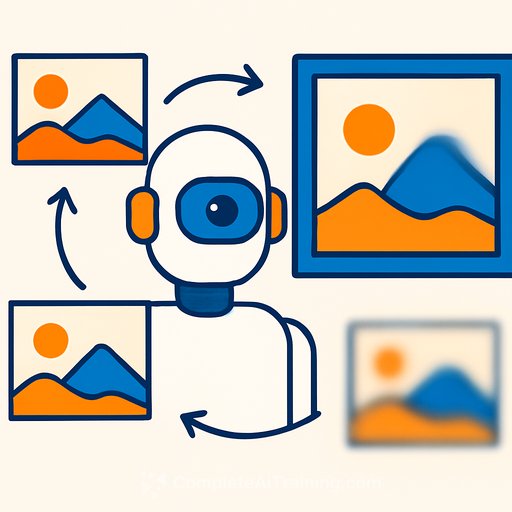
A study published in the data science journal Patterns shows that image models slide into the same handful of clichés. When researchers ran a "telephone game" between Stable Diffusion XL and LLaVA for 100 rounds, the outputs drifted off brief and clustered into just 12 visual motifs. For broader context on methodology and findings across similar work, see Research.
Think pastoral fields, rainy nightscapes, coastal beaches, and glossy interiors that look like stock photos with Gaussian blur. Across 1,000 iterations, the models didn't explore-they averaged. Creativity collapsed into safe, Western-centric defaults.
The study, in plain terms
Two models passed prompts back and forth: one generated an image, the other described it, then the first generated again from that description - repeated 100 times. The loop magnified the models' biases and revealed their comfort zone.
Instead of variety, the system regressed to a dozen predictable looks. Not because it's lazy, but because it optimizes for "what usually works" across its training data. That's probability, not taste.
Curious about one of the models used? See the LLaVA project.
What this means for your work
AI is great at speed and iteration. It's weak at originality. If you hand it the steering wheel, it will drive you to the same dozen destinations everyone else is visiting.
So treat AI like an assistant, not the author. You supply taste, direction, constraints, and the final call. That's the difference between art and output.
Practical ways to avoid "visual elevator music"
- Start with a clear creative intent. Write one sentence that states the message, mood, and audience. Hold every output to it.
- Ban the defaults. Use negative prompts for clichés (rainy streets, misty mountains, beige interiors, cinematic bokeh).
- Force novelty through constraints. Pick a time period, material, lens, or subculture reference that isn't common in stock imagery.
- Combine unlikely inputs. Blend two distinct art movements, eras, or mediums. Contradictions create texture.
- Iterate outside the model. Sketch first. Collage. Photograph materials. Feed your own assets to anchor the style.
- Break symmetry. Add imperfections: motion blur in odd places, hand-drawn overlays, texture scans, off-angle crops.
- Use multi-step workflows. Generate rough forms, then pass through specialized tools for lighting, color, and texture. Finish by hand.
- Fine-tune on your own references. A small, curated set beats a giant generic dataset. Teach the model your taste.
- Swap prompts for direction. Describe intention and constraints, not just "what to draw." You're briefing, not wishing.
- Edit like a photographer. Treat the output as a raw file: dodge, burn, grade, composite. Make decisions only a human would make.
Where AI still helps
Use it for mood boards, thumbnail studies, and exploring composition quickly. It's also useful for variations, object extraction, and layout testing before you invest time in final craft.
Keep the human in the loop for concept, story, and taste. That's where the value is-and where AI stumbles.
If you're integrating AI into a creative workflow
Pick tools and workflows that push beyond defaults, not toward them. A curated toolkit saves you from trend soup and stock-photo sameness.
If you want a quick scan of strong options, here's a vetted overview of AI tools for generative art. For practical courses and workflow guidance aimed at designers, see the AI Learning Path for UX/UI Designers.
The bottom line
AI optimizes for average. Creativity rejects average. If your work needs soul, you need to lead.
Use AI for speed and exploration. Keep originality, judgment, and taste in human hands. That's how you avoid the twelve tropes and make something that actually hits.
Your membership also unlocks: