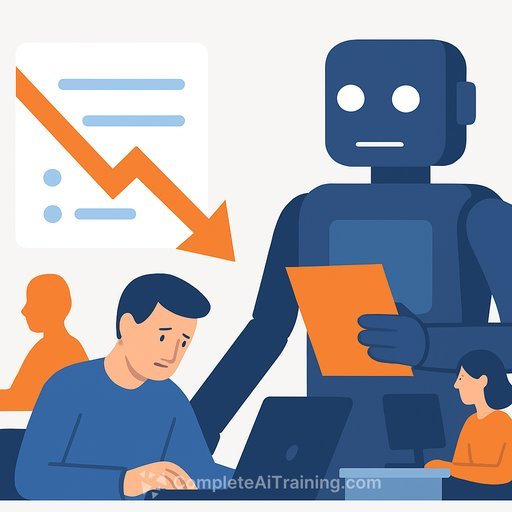
AI use at work has tripled in two years - and finance is on the front line
AI has moved from side project to daily workflow. Gallup's latest Workforce survey shows 12% of US workers now use AI every day and 25% use it several times a week. Nearly half interact with it at least a few times a year, up from 21% reporting any use two years ago. Tech and finance are leading adoption as generative tools became easy to access and deploy.
Why this matters for finance
Generative AI isn't just for engineers anymore. Tools that summarize filings, clean data, draft emails, and write basic code have compressed cycle times across the back office and front office. For finance teams, this means faster closes, sharper analysis, and fewer manual handoffs. The question isn't if AI fits your stack - it's where it moves the needle first.
High-ROI use cases you can implement now
- Forecasting and scenario planning: Generate multiple revenue, cash, and expense scenarios in minutes, then stress-test with macro prompts and driver tweaks.
- Month-end close acceleration: Auto-draft variance commentary, reconcile GL entries, and detect outliers before review.
- Management reporting: Condense long memos and board packets into crisp summaries with citations back to source tabs.
- Credit and risk review: Extract key metrics from financial statements, flag covenant risks, and draft credit memos for analyst review.
- Compliance and controls: Parse policy text, map controls to frameworks, and produce first-draft audit responses with document references.
- Investor relations: Turn raw data into draft Q&A, talking points, and consistent messaging across channels.
- Ops automation: Triage inboxes, route tickets, and generate responses for routine vendor and AP/AR inquiries.
Adoption is uneven - plan for the skills gap
Gallup finds tech workers use AI most: six in ten say they use it frequently and nearly a third use it daily. Professional services and academic settings are close behind. Economists are split on long-term productivity gains, but the labor shift is clear: computer-heavy roles adapt faster, while administrative and clerical roles face more exposure with fewer safety nets.
Research cited by the Centre for the Governance of AI identifies roughly 6.1 million US workers at higher risk of displacement, many in admin and clerical roles concentrated in smaller metros. Finance has equivalents - AP/AR clerks, payroll processors, report assemblers. Build a transition plan now: reskill into analysis, controls, vendor management, and AI-assisted QA.
A practical rollout plan for finance leaders
- Pick two processes to start: month-end commentary and forecast scenario generation. Define success as cycle-time reduction and error rate improvement.
- Use approved tools: restrict data access, disable training on company data, log prompts and outputs, and set role-based permissions.
- Create a prompt library: standardize prompts for commentary, risk flags, and summaries. Store examples with before/after outputs.
- Add AI to your control framework: peer review for all AI-generated text, source-citation requirements, and audit trails for material changes.
- Data governance: classify PII and sensitive financials, mask where possible, and keep models inside your VPC or vetted vendor boundary.
- Model risk management: document intended use, known failure modes, monitoring, and fallback procedures. Treat prompts like models - version them.
- Training plan: upskill analysts on prompt craft, spreadsheet automation, and basic scripting. Pair training with live projects, not theory - consider AI Productivity Courses for hands-on modules.
- Vendor due diligence: evaluate SOC 2, data retention, region, isolation, and fine-tuning policies. Bake service limits into contracts.
Metrics that prove value
- Close time: days to close and reviewer hours saved.
- Forecast quality: MAPE/MPE, variance explained, and number of scenarios reviewed per cycle.
- Throughput: reports produced per analyst per week and cycle-time per request.
- Quality: factual error rate in commentary, escalation rates, and audit adjustments.
- Cost: cost per ticket/inquiry and automation coverage (% of tasks with AI assist).
What the data says - and how to respond
Generative tools like ChatGPT - see ChatGPT for Professionals - lowered the barrier to automation, so usage spread fast. Gallup's figures suggest saturation in some high-skill sectors while the broader workforce is still adjusting. Whether this raises productivity or widens inequality will come down to how leaders deploy the tools and how they invest in people. In finance, the edge goes to teams that systematize AI use, keep tight controls, and redeploy clerical capacity into analysis and stakeholder support.
Sources: Gallup Workplace; National Bureau of Economic Research
Next steps
If you want a fast start - without guesswork - explore curated tools and training built for finance workflows. See a vetted list of AI tools for FP&A, accounting, and risk here: AI tools for finance.
Your membership also unlocks: