
AI news ·
AI automation of entry-level tasks hollows out the corporate leadership pipeline
Automating entry-level tasks hollows out middle management. Juniors lose the thousands of hours of manual practice needed to catch AI errors.
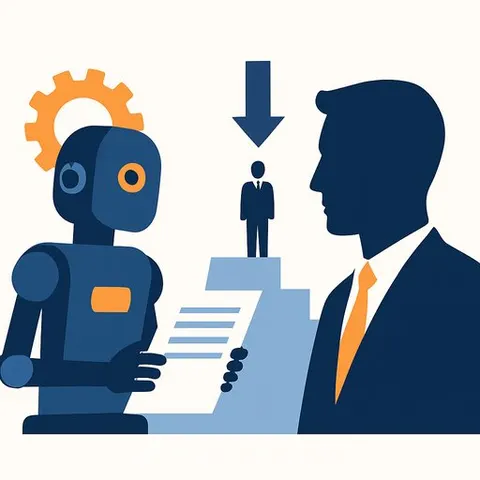
Multinational companies are automating entry-level tasks to cut costs, but this strategy is hollowing out the middle management tier required to build future executive teams. As generative AI absorbs foundational corporate work, organizations risk creating a leadership pipeline deficit that threatens long-term operational stability.
The hourglass organization and the detail gap
Corporate structures are warping into an unsustainable hourglass shape. At the top, senior executives hold institutional context. At the bottom, AI software executes tasks at high speed. The middle tier, where junior employees traditionally learned to manage operations, is evaporating.
Leadership intuition requires firsthand experience with granular execution. Junior financial analysts and software engineers previously spent thousands of hours building spreadsheets and writing baseline tests. "When you automate these entry-level jobs away, you aren't just cutting out friction. You are cutting out the very training grounds where people learn how to do the work."
Managers who have never performed manual tasks lack the experience to identify machine-generated errors. This creates a quality slump where leaders cannot spot anomalies because they have not committed the errors themselves.
Operational risks of blind supervision
Accountability suffers when supervisors view the underlying work as a mystery. If an AI error halts a production line, a supervisor without manual experience cannot take ownership and often blames the algorithm.
Junior managers also fail to act as an early-warning system for systemic risk. Without the hard-earned experience of manual failure, they pass flawed machine work up the corporate ladder. This leaves senior leaders unaware of operational crises until they affect quarterly financial statements.
Re-engineering early-career training
Companies must transition junior roles from creating content to auditing AI output. The primary performance metric should shift from production speed to the ability to identify the nuanced errors AI misinterprets or omits. Executive teams can use frameworks like the AI Learning Path for CEOs to restructure early-career tracks and rebuild the leadership pipeline.
Before deploying an autonomous agent for high-stakes tasks, junior employees must defend the manual logic required to complete the work. If an analyst cannot outline the core steps on a whiteboard, they lack the context to evaluate the machine's output. To support this transition, companies should invest in AI for Management programs that train leaders to supervise automated workflows and develop junior staff.
Organizations must also inject bad data and flawed assumptions into internal workflows. Forcing young professionals to hunt down engineered bugs builds the defensive judgment reflexes that manual work previously provided. Finally, corporations must mandate rotational manual deep-dives. Junior personnel should execute at least one major operational workflow per month entirely without AI infrastructure to preserve a human-centric benchmark of core capabilities.
Why this matters for executives and strategy professionals
Optimizing strictly for short-term operating margins by automating entry-level roles creates an unsustainable talent deficit. Executives must treat early-career assignments as a critical leadership laboratory rather than an expensive cost center, ensuring the next generation of managers can actually oversee the AI systems driving the business.