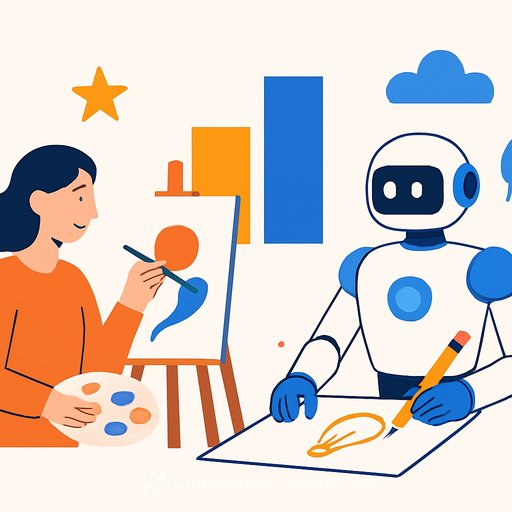
AI and humans collide in the biggest creativity test yet: what it means for creatives
AI just beat the average human on a creativity benchmark. Before you roll your eyes or panic, there's nuance. The study measured a narrow slice of creativity, and the best humans still outperformed the machines by a wide margin.
What the study actually measured
Researchers at Université de Montréal put 100,000 people up against leading large language models (LLMs) in the Divergent Association Task (DAT). It's simple: list 10 words in four minutes; the less related they are, the higher your "divergent creativity" score. Models did the same task under the same rules.
LLMs scored higher than the average participant, but about half the humans still did better. The top 10% of humans beat the models handily. In creative writing tests-haikus, film synopses, short stories-the pattern held: standout humans came out on top, even if the models looked decent on average.
If you're curious about DAT's background, see the original research on the method in PNAS here. The new study appears in Scientific Reports.
The real takeaway for creatives
This isn't a human vs. machine death match. It's a reminder that creativity is multi-dimensional, and benchmarks capture a slice-not your taste, story sense, or lived experience. The models look "creative" when the task is narrow and the instructions are sharp.
Translation: direction matters. Give an LLM a clear brief with constraints, voice, and references, and it becomes a strong collaborator. Leave it vague, and you'll get generic sludge.
How to use AI without losing your voice
- Write the brief you wish clients gave you: audience, tone, constraints, banned clichés, and success criteria.
- Prompt in stages: ideate 20 options → shortlist 5 → combine the best parts → rewrite in your voice.
- Force original angles: ask for ideas that combine two distant domains, then push for stranger, simpler, or more specific variants.
- Ground in truth: feed your own notes, interviews, or source material. Ask the model to cite and preserve facts.
- Impose taste filters: "No platitudes. No stock phrases. No empty adjectives. Show, don't tell."
- Build negative examples: share what you dislike and why; tell it to avoid those patterns.
- Use AI for friction points: headlines, outlines, alternate endings, beat sheets, moodboards with text descriptors.
- Keep authorship where it matters: your thesis, structure, and final pass.
Quick prompt patterns to test
- "Generate 15 concepts that combine [Theme A] with [Theme B]. Remove any that feel derivative; explain why each survivor is distinct."
- "Rewrite this paragraph in my voice: [paste sample]. Keep sentence length varied, avoid filler, and cut any vague claims."
- "Give me five unexpected metaphors for [topic], each rooted in concrete sensory detail. No clichés."
- "Offer three opposing viewpoints on this idea, then synthesize a tighter, stronger stance that addresses the objections."
- "Outline three film synopses in [genre] with a left-field twist at the midpoint. No tropey resolutions."
What about the pushback?
There's growing resistance to AI-generated content that exploits artists or floods feeds with low-effort output. Fair. That's exactly why intent and craft matter. Use AI to explore breadth fast, then rely on your taste to cut, combine, and refine.
The study's authors argue we should stop framing this as humans versus machines and start treating AI as a collaborator. That framing serves creatives best: you keep the vision; the model speeds the messy middle.
If you want to go deeper
Looking for structured workflows and prompt systems for your specific role? Explore curated options here:
- AI courses by job
- Prompt engineering playbooks
- For further reading on evaluation methods and study design, see our Research tag.
Bottom line: AI can hit average-level creativity on narrow tasks. The best humans still set the bar. Use the tools for scale and iteration, keep your taste in the driver's seat, and your work will stand out.
Your membership also unlocks: