AI Now Beats the Average Human on Some Creativity Tests - Here's What That Means for Creatives
New research led by Professor Karim Jerbi at the Université de Montréal, with contributions from Yoshua Bengio and collaborators across Mila, Université Concordia, University of Toronto Mississauga, and Google DeepMind, shows a clear shift: large language models can outperform the average human on specific measures of divergent creativity. The study compared major models-ChatGPT (GPT-4), Claude, Gemini, and others-against data from 100,000 human participants.
The headline is big, but the nuance matters. The most creative humans still outscore every AI model tested, especially in the top 50% and the top 10% of performers. For working creatives, the takeaway is simple: AI is a strong assistant, not a replacement.
How Creativity Was Measured
The team used the Divergent Association Task (DAT), a quick test of divergent linguistic creativity. You generate 10 words that are as different in meaning as possible-think "galaxy, fork, freedom, algae, harmonica, quantum, nostalgia, velvet, hurricane, photosynthesis."
DAT scores align with performance in idea generation, creative writing, and problem solving. It's fast (2-4 minutes), accessible, and a fair way to compare humans and AI under the same rules.
From Word Lists to Writing
The researchers went further and tested creative writing: haiku, plot summaries, and short stories. The pattern held. Some models topped the average human, but skilled human creators maintained a clear edge.
What This Means for Your Workflow
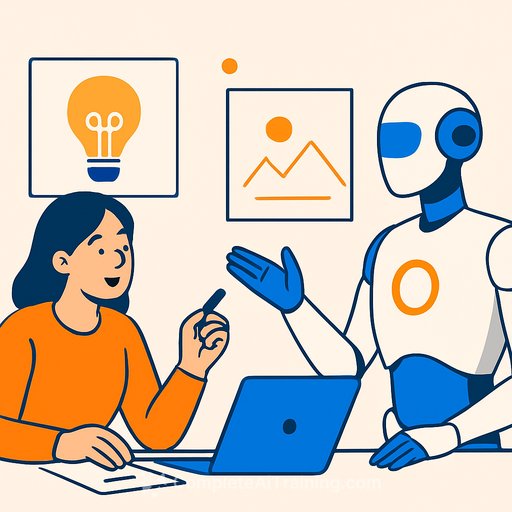
Treat AI like a creative partner that accelerates exploration, not a final voice. Use it to widen your option set, then apply your taste, lived context, and editorial judgment to choose and refine.
- Idea sprints: Generate 30-50 angles, then shortlist and iterate yourself.
- Constraint play: Ask for ideas within tight rules (tone, structure, audience, taboo words).
- Hybrid drafting: AI for raw clay; you handle structure, narrative tension, and voice.
- Alt takes: Request unexpected associations via word origins and structure (etymology, morphology) for fresher jumps.
- Self-competition: Pit your best against AI outputs; keep what wins, remix the rest.
Temperature and Prompt Levers
Temperature controls how adventurous the model gets. Lower values (~0.2-0.4) are safer and consistent; higher values (~0.7-1.0) are riskier and more original. If your tool exposes this setting, test ranges and save presets for different projects.
- For tight brand copy: lower temperature for clarity and control.
- For concepting and moodboards-in-words: higher temperature for range and surprise.
- Prompt nudge that works: "Consider the origins and structure of words (etymology/morphology). Offer unexpected associations."
Prompts You Can Use Today
- "Generate 12 highly dissimilar nouns. Cluster them into 3 themes. For each theme, pitch 3 campaign angles for [brand/product]."
- "Write 8 film loglines that fuse [Genre A] + [Genre B] with a constraint: include one image from marine biology and one from classical architecture."
- "Produce 20 headline starters for [topic]. Optimize for novelty. Then rewrite the top 5 to be punchy, specific, and benefit-led."
- "Before ideating, list 15 words tied to [topic] using etymology to expand meaning. Use those to craft 10 metaphor options."
Where AI Still Falls Short
- Taste and voice: Cohesive aesthetic judgment across a body of work.
- Creative risk with intent: Breaking rules for a reason, not at random.
- Lived context: Cultural nuance, timing, and subtext that lands.
- Conceptual synthesis: Turning disparate insights into an original core insight.
A Simple Creative Loop
- Brief: Define audience, job-to-be-done, tone, constraints, success criteria.
- Explore: Run 3-5 prompt paths at different temperatures. Save only what intrigues you.
- Expand: Combine fragments into 2-3 distinct directions. Strengthen logic, stakes, and specificity.
- Select and polish: Choose one direction and refine for rhythm, voice, and clarity. Get human feedback.
Practice That Builds an Edge
- Daily DAT warm-up (2-4 minutes) to stretch your association range. Then ideate for 10 minutes on a real brief.
- Weekly "model mash": Compare outputs from 2 models. Note what each does well. Update your prompt library.
- Keep a swipe file of your best AI-assisted ideas and final human edits to train your own taste.
Bottom Line
AI can beat the average, but the best human creators still win where it counts. Use AI to go wider and faster. Use your judgment to go deeper and make it yours.
Further Reading
- Scientific Reports: Divergent creativity in humans and large language models
- Try the Divergent Association Task (DAT)
Helpful Resources for Creatives
Your membership also unlocks: