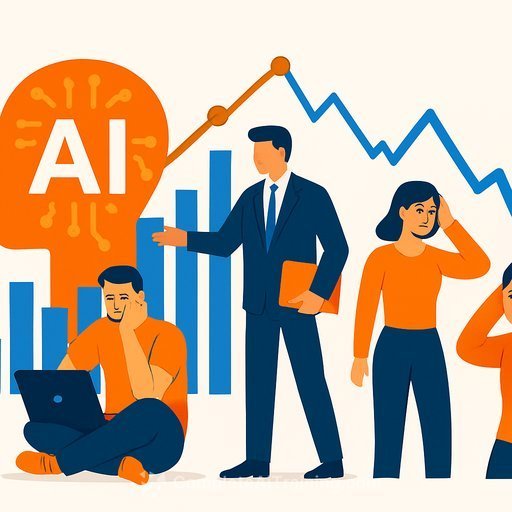
Is There an AI Bubble? What Finance Needs to See Before It Pops
Major institutions are waving caution flags. The Bank of England warns the risk of a sharp correction has risen as AI-fueled tech valuations stretch toward dotcom-era levels. The IMF echoed the concern, noting that a fast turn in financial conditions could hit global growth.
At the center: tech now makes up roughly 40% of the S&P 500, sentiment is extreme, and expectations assume flawless execution across chips, power, and data centers. When one theme drives index returns, fragility increases.
Why the exuberance
Some forecasts envision a step-change in productivity. Others see modest gains near 0.7% per year over a decade. The spread is wide, which is the point: nobody knows where the benefits will land, but prices are behaving as if the high end is a given.
Where valuations look stretched
- Index concentration: tech near 40% of the S&P 500 increases systematic risk.
- Private marks: headline valuations (e.g., mega-unicorns near $500B) with limited profits.
- Capex wave: massive data center buildouts and long-dated paybacks priced as certain.
- Dependency chain: chips, power, land, and grid capacity with real bottlenecks.
Plumbing risks that can break the thesis
- Power constraints delay deployments or raise unit economics.
- Chip supply and cost curves normalize slower than expected.
- Data access or policy shifts alter model training and usage.
- Architecture changes reduce demand for today's infrastructure mix.
Portfolio implications: What to do now
Assume optimism persists, but price in friction. Manage exposures, stress cash flows, and be precise about where returns actually come from.
- Map exposure: equities, credit, convertibles, private funds, and customer concentration to AI leaders.
- Stress test: -30% to -50% moves in top AI names and suppliers; check VaR, liquidity, and redemption timing.
- Earnings discipline: monitor revenue per GPU-hour, gross margin trend, and SBC as % of revenue.
- Capex sanity: track capex/revenue, FCF after growth capex, ROIC vs WACC, and payback periods.
- Second-order plays: utilities, power developers, and data center REITs-watch power pricing, contracts, and regulated returns.
- Hedges: put spreads or collars on high-beta AI baskets, dispersion trades, and quality vs story-stock spreads.
- Credit focus: covenant quality for data center builds, refinancing walls, and supplier/customer concentration.
- Policy risk: export controls, antitrust, and AI safety rules-set event-risk limits around known catalysts.
What the builders are signaling
Leaders expect misallocated capital in the short term and sustained gains over time. Some call this an industrial bubble: painful, but it leaves durable winners and infrastructure. Others argue the shift to more capable agents will improve unit economics as systems reason, use tools, and produce useful work.
Meanwhile, enterprise buyers are pressing harder on ROI. As hype cools, budgets move to tools that reduce costs or drive measurable revenue, not demos.
Metrics that will separate winners from passengers
- Revenue/compute cost ratio and inference gross margin trend.
- Customer adoption: cohort retention, seat expansion, and RPO growth.
- Unit economics: CAC payback, net dollar retention, and delivery costs per task.
- Capital intensity: capex/revenue, FCF after growth capex, and contract length for power/data center capacity.
Catalysts to watch over the next 6-12 months
- Evidence that AI agents handle real work with lower human oversight.
- Enterprise pilots moving to production with budget consolidation.
- GPU availability, pricing, and the shift from training to inference spend.
- Power additions, grid upgrades, and permitting timelines.
- Breadth of market leadership and earnings revisions in AI-linked sectors.
- IPO window reopening for AI infra and application names.
Bottom line
Treat AI as a capital cycle, not a certainty. Pay for proven cash flows, discount promises, and keep dry powder for forced sellers if a correction hits. The winners will show improving unit economics, durable demand, and return discipline while everyone else sells growth funded by dilution.
Sources and useful links
- Bank of England: Financial Stability Report
- IMF speeches and news on global financial conditions
- Practical AI tools for finance: quick scan of use cases and vendors
Your membership also unlocks: