AI Data Center Expansion: What Real Estate and Construction Teams Need To Know
AI demand is rewriting the site plan for power, water, and land at an unprecedented scale. The U.S. already hosts 5,426 data centers and 51% of the world's hyperscale AI facilities, with growth continuing, per All About AI.
Big checks are hitting the table. According to Forbes, the past year saw separate $50B commitments from Amazon and Anthropic tied to data center capacity, an OpenAI-Oracle contract to buy $300B in computing power over five years, and a proposed $500B "Stargate" venture involving OpenAI, Oracle, and SoftBank. The intent is clear: secure footprint, secure power, secure advantage.
The Footprint: Hundreds of Acres, Multi-Million Sq Ft
Projects are scaling fast and large. Reporting indicates the Stargate flagship in Abilene, Texas is planned at roughly 875 acres-about the size of Central Park-with 10 additional Texas sites in motion, including one at 1 million square feet.
Suburbs are in play too. In Elk Grove Village, Illinois, Stream Data Centers bought an entire subdivision of 55 homes in 2023 for a planned 2.1 million square foot facility, with buyouts reported at $950,000 per home.
Community Pushback Is Real (and Growing)
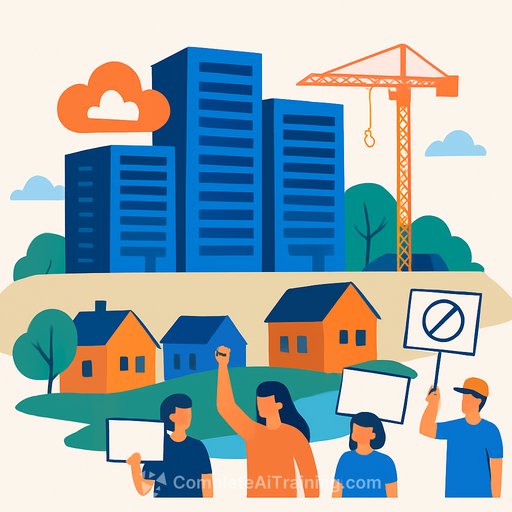
Residents want a say in what lands next door-especially when projects feel "done" before the public hears about them. Water stress, noise, and proximity to homes are common complaints. The BBC reported a Georgia homeowner near a Meta site facing low water pressure and sediment in taps-exactly the kind of story that galvanizes opposition.
Local governments are starting to pump the brakes. According to NPR, 16 data center projects were delayed or rejected nationwide between last May and this March. For developers and GCs, that means entitlement risk is no longer a footnote-it's a critical path item.
What This Means for Site Selection and Entitlements
- Power first, then everything else: Verify grid capacity, interconnection timelines, and substation feasibility up front. Long-lead electrical gear can blow up schedules if not locked early.
- Water is a gating factor: Quantify potable and non-potable needs, cooling approach (air vs. liquid vs. hybrid), and access to reclaimed or industrial water. Secure rights, redundancy, and contingency plans.
- Zoning and setbacks: Prioritize parcels with by-right data center use or clean paths to special use permits. Model noise, traffic, and generator emissions early to avoid last-minute surprises.
- Fiber and latency: Map carrier access, backhaul routes, and dark fiber options. IRUs and route diversity matter as much as megawatts.
- Environmental and resilience: Check floodplains, heat island impacts, and heat-reuse opportunities. Bake in on-site storage, peak-shaving, and grid services to ease utility negotiations.
Construction Reality Check
- Schedule risk: Transformers, switchgear, chillers, and generators are classic bottlenecks. Pre-purchase and modularize where possible.
- MEP coordination: High-density AI loads drive cooling intensity. Validate structural support for racks, containment strategies, and phased fit-outs tied to hardware refresh cycles.
- Permitting and air quality: Emergency generation stacks trigger modeling and community scrutiny. Align with regulators early and document mitigations.
- Noise and neighbors: Cooling plants and gensets create constant low-frequency noise. Invest in enclosures, barriers, and siting that defuses complaints before they happen.
Deals, Annexations, and Community Agreements
- Land control: Use options and phased takedowns to manage capital while entitlements mature. Tie closings to power and permit milestones.
- Annexation strategy: Line up tax agreements, PILOTs, or abatements with clear public benefits. Transparency beats a backlash later.
- Community benefits: Fund water offsets, road improvements, training pipelines, and small business contracts. Consider home-value protection zones or voluntary relocation support in close-proximity areas.
- Jobs claims vs. reality: Construction jobs are substantial; ongoing headcount is lean. Calibrate messaging and deliver concrete benefits residents can see.
Field Checklist: Start Here
- Grid letter of intent, interconnection study, and substation path confirmed.
- Water rights secured (primary and backup), with cooling selection locked.
- Zoning/by-right use validated; permit roadmap and timeline in writing.
- Noise, air, and traffic studies completed; mitigation budgeted.
- Fiber diversity mapped; carrier commitments documented.
- Long-lead equipment procurement released; modular design evaluated.
- Community engagement plan launched before filings; benefits quantified.
- Tax incentives memorialized; milestones tied to performance.
Bottom Line
AI data centers are becoming a dominant asset class. The teams that win will secure power early, de-risk water, over-communicate with neighbors, and design for speed without painting themselves into a corner on operations.
There's plenty of capital chasing sites. The scarce resources are megawatts, permits, and trust. Solve for those, and the rest gets easier.
Your membership also unlocks: