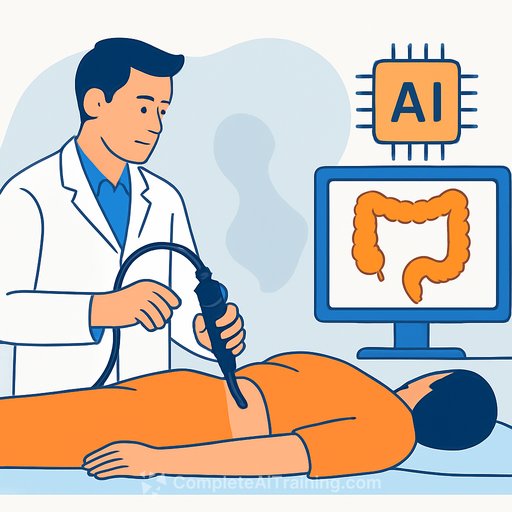
AI in Colonoscopy: Helpful Assist or Risk to Clinical Skill?
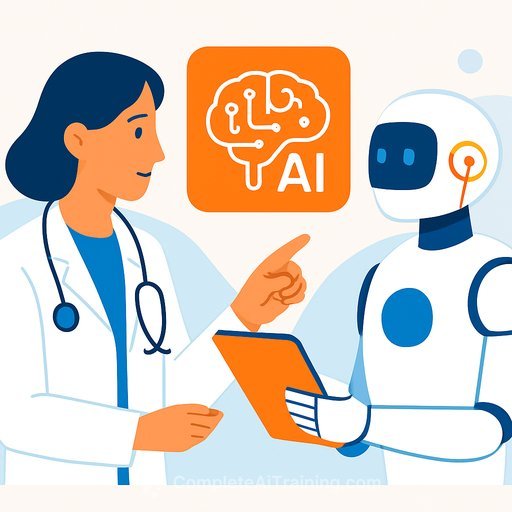
AI has moved from pilot projects to everyday use in endoscopy suites. Detection rates have gone up, workflows feel smoother, and teams trust it as a second set of eyes.
But a recent study signals a trade-off: over time, clinicians may become less sharp when the assist isn't there. That has real implications for patient safety and training.
What the study found
Researchers reviewed colonoscopies performed by highly experienced specialists before and after AI was embedded in routine practice. With AI on, detection stayed strong. No surprise there.
The twist showed up when the same specialists worked without AI several months later. Their ability to identify precancerous growths on their own dropped compared with their pre-AI baseline. The authors report this as the first study suggesting AI may negatively affect performance on a task with direct consequences for outcomes.
Why this matters for practice
Colonoscopy prevents bowel cancer by finding and removing precancerous lesions early. If reliance on AI dulls core visual and decision-making skills, patients are at risk during downtime, device failure, or in sites without access to the tech.
This isn't an argument against AI. It's a reminder that skill decay is real, and quality programs must adapt. The goal is simple: keep detection high with AI on, and keep clinicians sharp with AI off.
Practical safeguards you can implement now
- Track dual metrics: Report adenoma detection rate (ADR) both with AI and without it. Monitor drift quarterly. If off-AI ADR falls, intervene fast.
- Schedule "no-AI" sessions: Build protected lists or blocks where AI is disabled. Treat it like reps in a skills gym to retain pattern-recognition and scanning discipline.
- Targeted video review: Run post-procedure reviews with AI overlays hidden. Ask: what visual cues were missed, and why?
- Train failure modes: Teach where AI underperforms-flat lesions, poor prep, subtle color changes, edge-of-frame findings-and where it overcalls. Calibrate trust, don't outsource judgment.
- Refresh fundamentals: Re-emphasize withdrawal technique, mucosal exposure, and complete segment inspection. Technique first, tools second.
- Credentialing/CME updates: Include AI proficiency and off-AI competency in credentialing. Add periodic skill checks without assistive cues.
- Downtime protocols: Have a clear plan for outages: expectations, backup scopes, staffing, and supervision. Practice the plan, don't just write it.
- Human factors: Watch for "automation complacency." If the gaze follows the box, scanning narrows. Coach broad, systematic visual sweeps regardless of AI prompts.
What leaders and educators should do
Set the standard that AI augments skill-it doesn't replace it. Build quality dashboards that make off-AI performance visible and meaningful. Tie feedback to coaching, not blame.
For educator teams, evolve simulation and case reviews to rotate AI on/off. Create drills that stress subtle findings and technique under suboptimal conditions. Repetition beats novelty.
What to watch next
We need more data across centers, patient populations, and AI models. Key questions: How fast does skill drift occur? Which practices prevent it? What training dose maintains performance?
Until then, treat AI like any powerful clinical tool: measure its impact, design safeguards, and keep the clinician's eye sharp.
Source: The Lancet Gastroenterology & Hepatology
Want a structured path to build team AI literacy?
If you're formalizing training for clinicians, educators, or operations, explore role-based AI curricula that emphasize safety, oversight, and measurable outcomes: Complete AI Training - Courses by Job.
Your membership also unlocks: