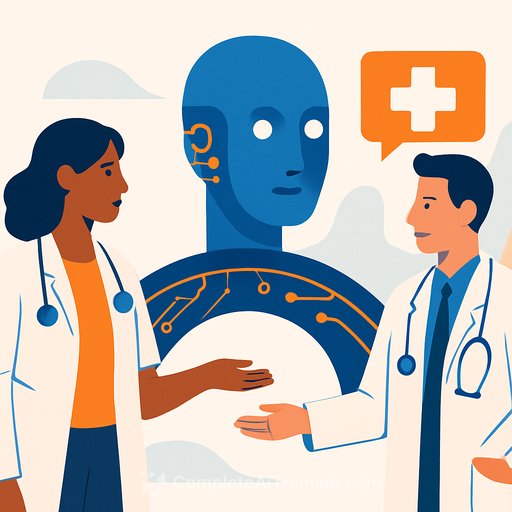
The Language/AI Incubator: Enhancing Communication in Health Care
The Language/AI Incubator, an initiative funded by the MIT Human Insight Collaborative (MITHIC), is focused on improving communication between patients and health care practitioners through artificial intelligence. This project brings together experts from diverse fields to address the challenges posed by language and cultural barriers in medical settings.
Generative AI is changing how people write, speak, and think across languages and cultures. In health care, communication gaps can lead to poor patient outcomes and hinder progress. The incubator seeks to build an interdisciplinary community grounded in the humanities to explore how AI affects cross-linguistic and cross-cultural interactions, especially in clinical environments.
Bridging Health Care and Language
The incubator is co-led by Leo Celi, a physician and senior researcher at MIT’s Institute for Medical Engineering and Science (IMES), and Per Urlaub, a professor in German and second language studies and director of MIT’s Global Languages program. They emphasize that the foundation of health care depends on accurate knowledge of health and disease, yet current communication systems are failing despite significant investments.
Celi and Urlaub met through MITHIC and discovered shared goals in using AI to improve medical communication. They believe language plays a critical role as either a bridge or barrier in health care delivery. Their collaboration includes social scientists who help address the non-neutral nature of language in medical contexts.
Exploring Communication Challenges
One area of study involves how patients describe pain. Urlaub joined Celi’s working group investigating metaphors for pain and their measurement. The team notes that tools like smiley face scales or numerical pain ratings may not translate well across different cultural and linguistic backgrounds, which can affect diagnosis and treatment.
Rodrigo Gameiro, a physician and researcher at MIT’s Laboratory for Computational Physiology, highlights the importance of responsible AI development. Building AI systems that process human language requires understanding the cultural and social meanings embedded in communication, especially in diverse patient populations.
Embedding Empathy in Science
The incubator team stresses the need for science and AI to maintain a human-centered focus. Celi points out that measuring success solely by academic outputs misses the goal of improving patient care. Urlaub adds that embracing “Epistemic Humility”—recognizing what we don’t know—is crucial in research and practice.
Creating environments where health professionals can admit biases and learn from one another is essential. Language reflects identity and power dynamics, which can influence patient comfort and openness during medical consultations. Misunderstandings rooted in cultural differences may lead to unsafe care.
Shifting Medical Communication with AI
AI’s growing language capabilities offer tools to support clearer and more culturally sensitive communication between patients and practitioners. Digital frameworks can provide context-aware assistance, helping bridge gaps in understanding. The team advocates for rethinking medical education and involving communities in shaping these solutions.
Biases carried by all parties in health care interactions remain significant challenges. The incubator aims to connect people with diverse perspectives and ensure AI serves inclusive purposes rather than excluding marginalized groups. Their approach favors collaboration and open dialogue to generate meaningful ideas and actions.
Collaborative Events and Future Plans
The Language/AI Incubator held its inaugural colloquium at MIT, featuring experts like Mena Ramos from the Global Ultrasound Institute, Alfred Spector from MIT’s Electrical Engineering and Computer Science Department, and Douglas Jones from MIT Lincoln Laboratory. A second colloquium is scheduled for August to continue advancing this work.
Greater integration of social sciences with technical research can reduce biases and improve patient-provider relationships. Giving patients and practitioners shared ownership over communication fosters better outcomes. AI can accelerate these changes by facilitating new ways to exchange information and address community needs.
Looking Ahead
While challenges remain—such as scaling technology, including underserved populations, and redesigning care models—the team remains optimistic. Celi stresses the importance of reconnecting science with society and acknowledging limitations in our knowledge. Gameiro views AI as a chance to redefine medicine’s reach and impact.
Urlaub emphasizes that education transforms people into active participants instead of passive subjects. Understanding how technology shifts these roles is vital for future care models.
The incubator leaders call for more spaces like MITHIC where health care innovation can happen without relying on traditional metrics of success. They aim to build communities open to uncertainty and diverse viewpoints. As Celi puts it, failure would mean they didn’t imagine bold enough possibilities for a new approach to health care communication.
For healthcare professionals interested in how AI can support better communication and patient care, exploring relevant AI courses and training may be a practical next step. Resources like Complete AI Training’s healthcare-related courses offer valuable insights into applying AI in clinical settings.
Your membership also unlocks: