Global growth cools. Policy mistakes won't be forgiven.
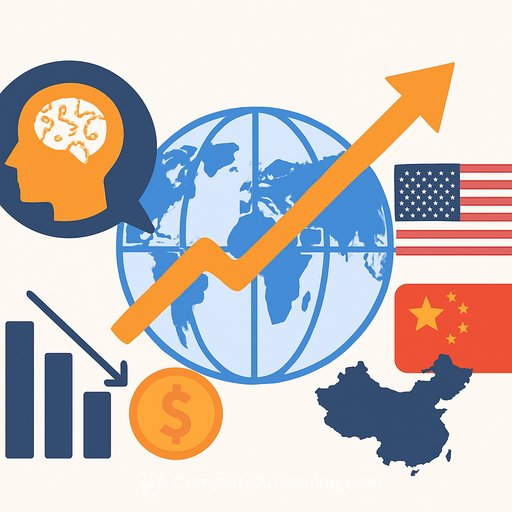
The OECD projects global growth at 2.9% this year, down from 3.2% last year. The IMF also expects a slower pace. That headline matters less than the drivers: artificial intelligence hype cycles, swelling government debt, and brittle trade relations.
For public leaders, the signal is simple: the economy can still move, but the margin for error is shrinking. Plan for shocks that spread fast through markets, budgets, and supply chains.
OECD Economic Outlook | IMF World Economic Outlook
AI is the swing factor
Jack Zhang (University of Kansas) notes that AI investment and data center construction effectively held up U.S. GDP last year. His worry: investor optimism can flip, and a bubble could burst as early as 2026.
Mark Blais (Brown University) warns that pouring capital into AI as if scale alone guarantees breakthroughs is a risky bet. With China pushing smaller distilled models and open-source alternatives, the U.S. monopoly is already eroding. If AI equities slide, the top 20%-who drive most U.S. consumption-pull back, and recession risk jumps.
Some estimates put potential losses near 8% of U.S. household assets (about $16 trillion) in a dot-com-scale correction. Frederik Erikson (ECIPE) adds that AI-heavy capex is crowding out other sectors, weakening labor demand and pushing unemployment higher.
Government debt is the second fault line
Global debt hit $345.7 trillion by Q3 last year, up 36% from pre-COVID levels, according to the IIF. Loose money plus expansionary budgets delivered growth-but left a bill.
Zhang's takeaway: many governments are borrowing from the future with uncertain long-run growth. Markets still tolerate high debt in advanced economies, but high rates and low growth are killing fiscal flexibility and shrinking the room for policy mistakes.
Erikson flags a higher risk of sovereign crises that could fracture the global economy. He cites the U.S. deficit near 7% of GDP and warns that politicizing the Federal Reserve's independence would raise the cost of everything.
Blais counters that the U.S. remains cushioned by dollar dominance and persistent global demand for U.S. assets. The sharper risks sit with lower-income countries and Eurozone members like France and Italy, which lack monetary sovereignty and can't inflate or devalue their way out.
U.S.-China: managed rivalry, unpredictable timing
Erikson sees both sides locked in a protectionist dance with little incentive to change. Zhang calls the relationship inherently unpredictable, but expects no immediate clash given domestic pressures on both sides.
Short-term, a ceasefire may hold into the spring, with more "managed trade" justified by security and narrow carve-outs for favored sectors. Zhang's concern: short-term wins can weaken the long-term stability of the system.
Blais reads the latest U.S. National Security Strategy as a pivot to dominate the Western Hemisphere while accepting a larger Chinese role in East Asia. Allies like South Korea and Japan may get encouragement and arms sales, but less active support. Net result: they need careful tightrope diplomacy, given deep economic ties with China.
What public leaders should do now
- Run AI-shock scenarios: model a rapid equity drawdown, tighter credit, and a consumption hit from upper-income households.
- Stress test budgets: assume slower revenue, higher unemployment benefits, and delayed capital projects. Pre-plan triggers for spending reprioritization.
- Rebuild fiscal buffers: set clear deficit anchors, stage medium-term consolidation, and protect growth-enhancing public investment.
- Protect central bank independence and credibility. Anything that blurs it will raise funding costs immediately.
- Map supply-chain exposure to "managed trade" rules, export controls, and carve-outs. Secure alternative suppliers before restrictions bite.
- Target support to sectors starved of capital by the AI boom if they are systemically important (energy grids, logistics, critical manufacturing).
- Prepare labor policy for uneven demand: rapid re-employment services, portable benefits, and skills programs tied to real vacancies.
- For emerging and lower-income economies: front-load debt reprofiling talks, build FX liquidity backstops, and tighten non-essential imports.
- For Eurozone members at risk: coordinate with EU institutions early, align fiscal paths with market reality, and avoid pro-cyclical cuts.
Signals to watch
- AI capex and data center build rates vs. earnings quality at major AI firms.
- Equity concentration in mega-cap AI names; breadth of gains across sectors.
- Labor market breadth outside AI-adjacent industries; quits and hours worked.
- Sovereign spreads for vulnerable borrowers; rollover needs vs. FX reserves.
- U.S. deficit trajectory and any moves that threaten monetary policy independence.
- New "managed trade" measures, export controls, and sector carve-outs.
- U.S.-China diplomatic calendar slippage or surprise restrictions.
Capability building (quietly beats big bets)
Most risks here compound through confidence. Competence reduces that. Build small, repeatable processes for fiscal discipline, procurement, data-sharing, and crisis communication. Then practice them.
If your team needs structured AI literacy for policy, procurement, or workforce planning, see this curated catalog: AI courses by job. As one entry-level option for structured basics, consider the AI Learning Path for Primary School Teachers.
The year will likely be slower, not catastrophic. But the system is less forgiving. Boring, consistent policy will do more for growth-and stability-than heroic last-minute rescues.
Your membership also unlocks: