AI can learn cultural values the way kids do
AI systems don't operate in a vacuum. They absorb norms and values from data. The problem: values vary across cultures, and one-size-fits-all models misfire in practice.
A new University of Washington study suggests a path forward. Train AI to learn values the way children do-by watching people in their own communities and inferring what matters. The work, published January 11, 2026 in PLOS One, shows that value learning via observation can transfer beyond the training task.
The big idea: learn values from behavior, not rules
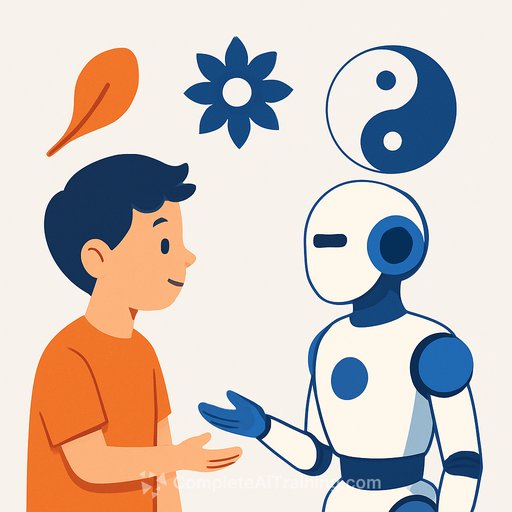
"We shouldn't hard code a universal set of values into AI systems, because many cultures have their own values," says Rajesh Rao, professor in the Paul G. Allen School of Computer Science & Engineering and co-director of the Center for Neurotechnology. "So we wanted to find out if an AI system can learn values the way children do, by observing people in their culture and absorbing their values."
Andrew Meltzoff, professor of psychology and co-director of I-LABS, adds: "Kids learn almost by osmosis how people act in a community or culture. The human values they learn are more 'caught' than 'taught.'"
Study design in brief
- Participants: 300 adults (190 identifying as white; 110 identifying as Latino).
- Task: a modified Overcooked game focused on cooking and delivering onion soup.
- Setup: Players could see a second kitchen where a bot was at a disadvantage and periodically asked for help (e.g., sharing onions). Helping reduced the player's own output-an operational measure of altruism.
- AI: Two agents, each trained on one group's behavioral data using inverse reinforcement learning (IRL).
Why IRL? In reinforcement learning (RL), systems optimize explicit rewards. In IRL, agents infer the underlying rewards and goals by watching behavior-closer to how humans generalize from examples. This approach connects to ongoing Research into human-like generalization and value inference.
Key findings
- On average, participants in the Latino group helped more than those in the white group in the game.
- The AI agent trained on Latino data learned a higher propensity for altruism and gave away more onions during play.
- Generalization test: In a separate donation scenario, the same agent also chose to give more-evidence that the learned value (altruism) carried beyond the original task.
Why it matters for science and engineering
Values differ by culture and context. Hard-coding ethics glosses over those differences and produces brittle systems. Learning value functions from local behavior offers a scalable way to align AI with the communities it serves.
As Rao notes, this approach could let companies fine-tune models on culture-specific data before deployment-without inventing universal rules that fit nobody well. Thoughtful system Design and deployment practices are essential to avoid stereotyping or misuse.
Practical takeaways for researchers and builders
- Collect behavior-first datasets. Capture real decisions, trade-offs, and help-giving in the target community (with consent and privacy protections).
- Use IRL to infer latent reward functions that reflect local norms (e.g., fairness, reciprocity, altruism) instead of scripting them. Strong Coding practices help implement reliable IRL pipelines and evaluations.
- Test for transfer. Evaluate whether learned values hold in out-of-distribution tasks, not just the training scenario.
- Support regional fine-tuning. Maintain pipelines to adapt and reweight value functions for new locales and subcultures.
- Monitor conflicts. When values collide (e.g., efficiency vs. generosity), surface trade-offs and allow stakeholder oversight.
- Instrument auditing. Track behavioral metrics by group, watch for drift, and run A/B tests to verify culturally relevant outcomes.
Limitations to keep in mind
- Two cultural groups and a simplified lab setting (Overcooked). Real-world messiness-richer contexts, time pressure, social dynamics-will stress these methods.
- Altruism was measured via specific choices (sharing onions, donating money). Other values (fairness, reciprocity, hierarchy, privacy) may interact or compete.
- Scaling requires careful data stewardship: informed consent, anonymization, and guardrails against stereotyping or essentializing cultures.
Where to read more
Original study in PLOS One (DOI): 10.1371/journal.pone.0337914
Skill-building
If you're integrating cultural value learning into your AI stack, curated training can help you plan data collection, IRL pipelines, and evaluation. Explore role-based options here: Complete AI Training - Courses by job.
Your membership also unlocks: