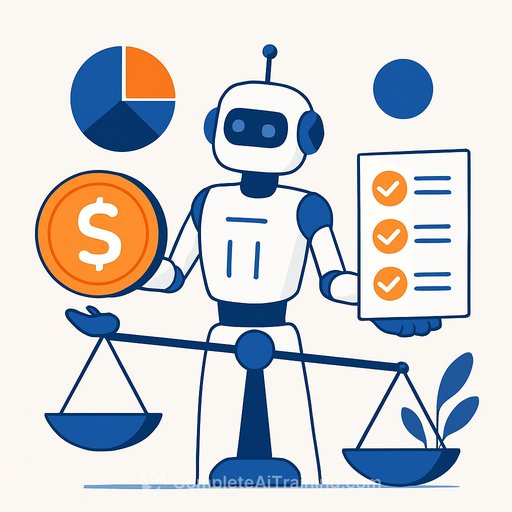
AI in Personal Finance: The Promise and the Limits
Your phone flags an odd spending pattern and nudges a $50 transfer to avoid a fee. Later, your robo-advisor trims gains, harvests losses, and resets your allocation. That's AI doing what it does best: pattern recognition at scale, with quick, low-friction actions that keep your money moving the way you intended.
For finance professionals, this isn't hype - it's workflow. The question is how to use these tools for real outcomes while staying grounded in client values, compliance, and risk; governance and strategy considerations are covered in AI for Executives & Strategy.
What AI can actually do for your wallet
- Cash flow vigilance: Auto-categorize transactions, flag anomalies, forecast bills, and trigger low-balance sweeps before fees hit.
- Credit and bills: Monitor credit changes, suggest budget shifts, and even negotiate lower rates for utilities and subscriptions.
- Investing basics on autopilot: Construct diversified portfolios, rebalance on schedule, and apply tax-loss harvesting to reduce drag.
- Education on demand: Q&A style explainers and interactive lessons that make complex topics digestible for clients and teams.
Used well, these features cut busywork, reduce errors, and free time for higher-level analysis. That's where your expertise pays off - and where practical implementations live in the space of AI for Finance.
Where the algorithms hit a wall
AI is great at math, weak at meaning. It doesn't know if a client values sustainability over total return, or how to weigh retiring early against funding a child's education. It won't read the room during a health scare, a layoff, or a messy life transition.
There are technical and ethical limits too: bias in training data, model drift, incomplete context, privacy risks, and unclear accountability when an automated nudge goes wrong. Pre-set logic also struggles with complex planning needs like cross-entity tax strategy, trusts, or multi-generational wealth plans.
Why the human advisor still matters
- Long-term perspective: Keep clients steady when markets shake - and keep short-term noise from derailing compounding.
- Goal coordination: Align partners, reconcile trade-offs, and surface goals people forgot they had.
- Accountability: Turn "we should" into "we did," even as life changes.
- Emotional clarity: Bring context, empathy, and judgment that software can't replicate.
Surveys in recent years consistently show that people working with a financial advisor and a clear plan report higher confidence than those going solo. The point isn't that AI is weak - it's that confidence comes from clarity and commitment, not just calculations.
The hybrid model: Practical playbook for finance teams
Think of AI as the calculator and you as the mathematician who decides which equations matter. Here's a simple operating model that scales. For workflow patterns and process design, see AI for Operations.
- Define use cases: Monitoring, alerts, and drafts first; keep a human in the loop for approvals, suitability, and trade-offs.
- Codify constraints: Document risk bands, tax and legal constraints, ESG preferences, and cash buffers so tools operate within guardrails.
- Data hygiene: Clean categorization, enriched metadata, and clear data lineage. Bad inputs make confident but wrong outputs.
- Review cadence: Measure drift, false positives, tax outcomes, and client impact. Adjust thresholds, not just models.
- Transparent disclosures: Explain what's automated, what isn't, and when a person steps in. Set expectations early.
- Security: Minimize PII exposure, restrict prompts, and log interactions. Treat prompts like production code.
- Escalation paths: Route edge cases to specialists (tax, estate, credit). Speed matters; so does precision.
- Outcome metrics: Track time saved, fee avoidance, cash drag reduction, and realized tax alpha - not generic "AI wins."
Client conversations that make AI better
AI gets smarter when your intake is sharper. Structure discovery around values and constraints, not just numbers. Capture what clients refuse to compromise on, what they'll trade, and what they want to avoid.
Then map those inputs to rules your tools can act on. That's how automation stays aligned with the person it serves.
Stay curious - and critical
Use AI for the heavy lifting: reconciling, alerting, drafting, and surfacing options. Use human judgment for meaning: priorities, timing, and trade-offs.
Want a curated view of practical AI tools for finance work? Explore this resource: AI tools for finance.
Further reading
Use the tools. Keep the wisdom. The strategy that wins is simple: let AI handle the repeatable, and let people handle what actually matters.
Your membership also unlocks: