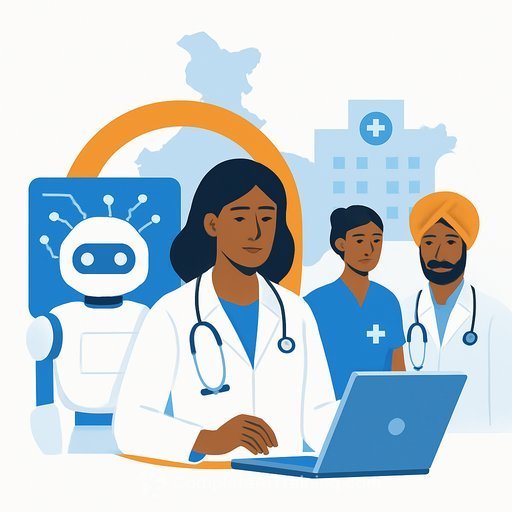
AI Can Dramatically Improve Health Care Productivity-But Only With System-Level Redesign
A new study from the Fraser Institute makes a clear point: AI can deliver major productivity gains in health care, but small, isolated tools won't get us there. Real impact comes when entire workflows are rebuilt with AI at the center-from intake and diagnosis to care coordination, administration, and research.
This isn't about adding another app. It's about rethinking the value chain so information moves without friction, routine work is automated, and clinicians focus on decisions and relationships.
Point Solutions vs. System Solutions
Today's "point solutions" (single-task AI tools) save minutes. System solutions can save hours, shorten backlogs, and increase capacity without burning out staff. Here's the difference:
- Clinical notes: A point solution transcribes visits. A system solution records the encounter, structures the note, updates the EHR, orders meds, books follow-ups, and surfaces abnormal results-end to end. For teams modernizing documentation, see the AI Learning Path for Medical Records Clerks.
- Research and discovery: A point solution screens literature or runs an analysis. A system solution designs experiments, executes protocols, adapts in real time, and feeds results back into models for the next iteration-what some call a self-driving lab. Explore tools and workflows under AI for Science & Research.
Where System-Level AI Fits Across the Care Journey
- Access & triage: Intake bots, symptom triage, and scheduling that level-load capacity across clinics and virtual care.
- Diagnostics: Imaging, pathology, and waveform models embedded into workflows, with automated pre-reads and quality checks.
- Care planning: Risk stratification, guideline-based order sets, and dynamic care plans personalized to comorbidities and social factors.
- Care delivery: Ambient documentation, task automation, and decision support at the point of care.
- Care coordination: Automated referrals, closed-loop follow-ups, and cross-site data sharing to prevent leakage and missed care.
- Operations & throughput: Bed management, OR block optimization, discharge prediction, and staff scheduling.
- Pharmacy & supply chain: Prior auth automation, formulary optimization, inventory forecasting, and waste reduction.
- Revenue cycle & admin: Eligibility checks, coding support, denial prevention, and patient financial engagement.
- Research & trials: Feasibility, cohort discovery, adaptive protocols, and automated data capture.
- Population health: Registry automation, gap closure, and targeted outreach for high-risk groups.
12-Month Playbook for Health Care Leaders
- Pick three measurable outcomes: Access (wait time), quality (readmissions), and cost (cost per case). Anchor every decision to these.
- Map the patient journey: Identify handoffs, duplicate data entry, and delays. Redesign the process first; add AI second.
- Unify your data layer: Stand up an interoperable data platform (FHIR-first) that connects EHR, imaging, labs, claims, and ops data.
- Embed into the EHR workflow: Deliver AI inside existing clicks and screens. No swivel-chairing between apps.
- Define safety and governance: Indications-for-use, human oversight points, audit logs, bias monitoring, and clear escalation paths.
- Start with high-yield work: Documentation, prior auth, imaging pre-reads, and discharge prediction typically pay back fast.
- Run controlled pilots: A/B test against baselines, measure throughput and error rates, then move from pilot to platform.
- Set up MLOps: Versioning, drift detection, performance dashboards, and a rollback plan for every model in production.
- Train the workforce: Role-based training for clinicians, coders, schedulers, and researchers. Keep sessions short and hands-on.
- Align incentives: Work with payers and leadership so time saved converts to added capacity, not just tighter schedules.
- Modernize procurement: Prefer vendors with open APIs, clear roadmaps, data portability, and transparent model cards.
- Track equity and safety: Segment outcomes by age, sex, race/ethnicity, language, and SDOH. Intervene where gaps appear.
Guardrails That Protect Patients and Trust
- Privacy and security by design: Minimize data movement, encrypt in transit and at rest, and log every access.
- Human-in-the-loop: Clinicians confirm critical decisions; automation supports, it doesn't overrule.
- Clinical validation: Prospective testing, defined operating points, and continuous monitoring in real settings.
- Transparency: Explainable outputs where feasible, clear limitations, and patient-facing disclosures for AI-assisted care.
- Interoperability: Use standards like HL7 FHIR to avoid data silos and vendor lock-in.
What This Means for Your Organization
The opportunity isn't a single tool; it's a coordinated operating model that reduces waste, improves flow, and frees clinicians to practice at the top of their license. Start with a few high-impact pathways, wire AI into the workflow, prove value, and scale.
For a deeper look at the study's findings, visit the Fraser Institute. If you're building AI capability across clinical workflows, explore curated insights under AI for Healthcare.
Your membership also unlocks: