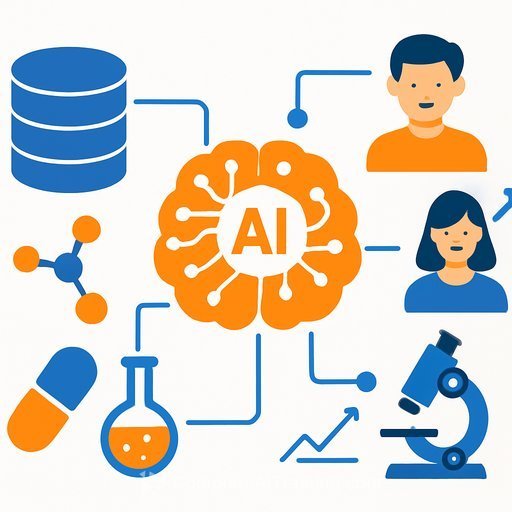
AI Can Accelerate Research-But It Won't Replace Scientists
AI is moving into every corner of Research. Models trained on scientific data are now used to suggest hypotheses, flag patterns, and automate parts of the workflow.
Policy is following suit. On November 24, 2025, the Trump administration announced the Genesis Mission-an effort to train AI agents on federal scientific datasets to test hypotheses, automate workflows, and speed up discoveries. Early results are mixed.
The reason is simple: AI can parse huge datasets and surface correlations humans miss. But without commonsense reasoning and domain intuition, it can also propose impractical experiments and misread spurious patterns as signals.
What AI Does Well in Science
- Processes large, messy datasets quickly and consistently.
- Finds subtle correlations and candidate features for further study.
- Suggests simulation parameters and narrows search spaces.
- Automates repetitive lab and analysis tasks with high throughput.
- Supports code generation, data cleaning, and documentation.
Where AI Falls Short
- Lacks causal understanding and often mistakes correlation for mechanism.
- Proposes experiments that ignore constraints like feasibility, safety, or cost.
- Struggles with external validity and edge cases outside training data.
- Inherits bias and measurement error from datasets and instruments.
- Offers confident suggestions without calibrated uncertainty.
AI Learns From Scientists-Not From Nature
Models don't observe reality directly. They learn from datasets that humans build, label, filter, and validate. The "world" the model sees is the one we encode.
That means any AI breakthrough is downstream of human judgment: what to measure, how to measure it, which examples qualify as ground truth, and which errors are acceptable. Without that scaffolding, models drift or overfit.
Consider AlphaFold. Its developers were awarded the 2024 Nobel Prize in chemistry for predicting protein structures. This capability has practical value for drug design and disease research and has already compressed timelines for structure inference.
But AlphaFold doesn't generate biological knowledge by itself. It accelerates analysis of existing information and guides where to look next. Validation, mechanism, and therapeutic impact still depend on experiments, interpretation, and theory-building by scientists. See the Nature paper on AlphaFold's accuracy for context: Nature: Highly accurate protein structure prediction with AlphaFold.
A Practical Playbook for Research Teams
- Start with a sharp question. Define the phenomenon, the causal hypotheses, and acceptable evidence before touching a model.
- Engineer the dataset. Specify inclusion criteria, provenance, labeling protocols, and quality checks. Document measurement error and missingness. The NIH guidance is a useful reference: NIH Data Management & Sharing.
- Establish baselines. Compare against simple models and heuristics. If a linear baseline wins, stop there.
- Constrain the model with science. Encode units, bounds, conservation laws, and domain priors. Penalize physically impossible outputs.
- Interrogate failure modes. Stress-test on out-of-distribution samples, adversarial cases, and data shifts that mirror real practice.
- Close the loop with experiments. Use AI to rank candidates, then validate with controlled studies. Update the dataset with outcomes-positive and negative.
- Track uncertainty and cost. Report confidence intervals, decision thresholds, and the budget/time needed to act on the model's suggestions.
- Audit and reproduce. Version data, code, and prompts. Share protocols. Independent replication beats benchmark scores.
How to Evaluate "AI Scientists" Initiatives
- Clear targets: What scientific questions are in scope, and what counts as success (prediction accuracy, a new assay, a validated compound)?
- Grounded constraints: Feasibility, safety, and ethics must be built into objectives, not patched on later.
- Provenance and governance: Dataset sources, licenses, privacy controls, and update policies should be transparent.
- External validation: Independent labs should replicate results before claiming breakthroughs.
- Negative results logged: Document what failed and why, so models don't chase the same dead ends.
Bottom Line
AI can compress search, triage options, and reduce tedious work. That's valuable.
But science is still a human endeavor-posing the right questions, designing clean tests, interpreting edge cases, and deciding what evidence is enough. Treat AI as an assistant that scales analysis, not as a substitute for theory and experiment.
If your team is building AI literacy for research workflows, see focused options by role: AI courses by job.
Your membership also unlocks: