AI in Healthcare: From Vision to Value
Artificial Intelligence can help deliver efficient care at scale, said Girish Krishnamurthy, Chief Executive Officer and Managing Director of Tata Medical and Diagnostics, at the inaugural Vision to Value Conclave 1.0 in Coimbatore, hosted by Rotary Coimbatore Ikons. His message was clear: adopt AI across the delivery system to keep people healthier and enable the country's economic aspirations.
He pointed to a shift in health needs and models. The public system before the 1970s worked at village and district levels, but lifestyle diseases and fragmented delivery have changed the equation. What's required now is continuous, connected, proactive care that stays close to the patient. Patient centricity isn't a slogan-it's an operating model.
Why this matters for health leaders
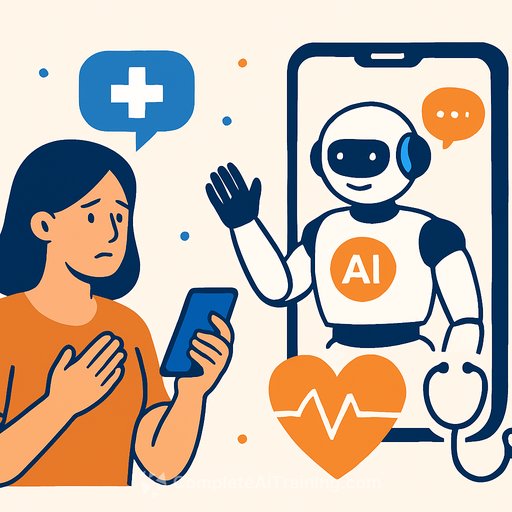
AI can help care teams predict risk, triage faster, and manage population health-without burning out staff. Think remote monitoring for chronic conditions, earlier interventions, and better resource allocation across districts. The goal isn't more dashboards; it's fewer avoidable admissions and better outcomes at a lower cost per patient.
That only happens if the system itself gets smarter and more efficient. Interoperable data, clear care pathways, and clinical governance are non-negotiable. With those in place, AI augments decisions and extends reach rather than adding noise.
Turning patient-centric care into practice
- Build continuous care loops: remote monitoring, teleconsults, and AI-enabled follow-ups for high-burden NCDs.
- Use risk stratification to prioritize outreach for diabetes, hypertension, COPD, and maternal health.
- Embed decision support into clinician workflows, not as an extra step.
- Set up data plumbing first: standardized coding, consent flows, and secure data exchange.
- Track results that matter: time-to-diagnosis, adherence, readmissions, and cost per outcome.
Leadership signals from industry
Jairam Varadaraj, Managing Director of Elgi Equipments, noted that businesses now have a global opportunity-and purpose should anchor profit. For hospitals and health-tech teams, that means tying revenue to measurable patient outcomes and long-term trust, not short-term volume.
L.V. Navaneeth, Chief Executive Officer of The Hindu, emphasized the blend of people, product, and processes. Leadership, he said, is knowing yourself, knowing your people, helping teams know one another, and opening that network to the outside world. In healthcare, that translates to cross-functional teams that ship improvements, not committees that stall them.
Conclave chair Hari Padmanabhan framed the aim of the event simply: conversations that spark ideas and inspire action. The Hindu is the media partner for the event.
Action checklist for the next 90 days
- Pick two high-impact use cases (e.g., readmission prediction for heart failure; AI triage in emergency). Define success in one page.
- Run a data readiness check: sources, quality, gaps, and consent. Fix what blocks you from reliable outputs.
- Create a clinical and ethics review lane to approve models, monitor drift, and handle escalation.
- Pilot in one unit or district with clear KPIs. Integrate with the EHR; avoid parallel workflows.
- Train the care team on how to use AI outputs-and when to ignore them. Document decision overrides.
- Measure equity and access: who benefits, who's left out, and what adjustments are needed.
- Scale only after you've proven clinical benefit, cost impact, and staff acceptance.
Guardrails and resources
- Ethics and safety: see the WHO guidance on AI for health for practical guardrails.
- Workforce enablement: if your team needs structured upskilling on AI tools and workflows, explore practical AI training by job role. For teams implementing models and integrations, consider focused Coding training to build reliable pipelines and integrations.
The takeaway
AI won't fix healthcare by itself. But with patient-centric Design, tight data foundations, and accountable leadership, it can extend care, reduce waste, and move population health in the right direction-at scale.
Your membership also unlocks: