AI in the legal profession: helpful assistant, not a replacement
AI is moving into legal workflows across India. It speeds up research - see our Research resources - along with sorting and drafting. Still, law runs on interpretation, ethics, and human judgment-especially in a system guided by one of the longest constitutions in the world.
Use the tools, but set hard boundaries. The goal is higher-quality work, done faster, without compromising client trust or professional duty.
What AI is good at today
- Reading, sorting, and analyzing large volumes of text
- Pulling relevant cases, statutes, and precedents from thousands of pages
- Highlighting issues, extracting timelines, and flagging gaps
- Drafting standard agreements and first-draft briefs
- Summarizing lengthy case files into workable notes
These are speed-and-consistency problems. Machines handle them well. Let them.
Where AI adds speed-and where it stops
AI is useful for discovery review, due diligence, contract comparison, case law search, and templated drafting. It helps cut repetitive work so you can spend more time on strategy.
But it can't replace legal strategy, courtroom advocacy, complex negotiations, credibility assessment, or ethical decision-making. Matters involving family disputes, criminal defense, sensitive investigations, and mediation require human presence and accountability.
The empathy and ethics gap
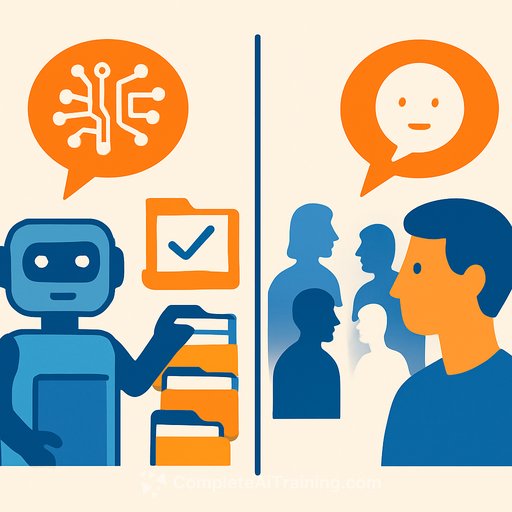
AI cannot understand emotions or show empathy. It can detect patterns in language but it doesn't feel, relate to trauma, read a room, or weigh moral trade-offs.
That gap matters. Negotiations, client counseling, and sentencing arguments often turn on human nuance. Treat AI as a powerful helper, not counsel.
Practical workflow for firms and chambers
- Define scope: List tasks AI may perform (research summaries, clause checks) and tasks it may not (final legal opinions, settlement strategy).
- Human-in-the-loop: Require partner or senior review on every AI-assisted output before anything leaves the building.
- Data hygiene: Strip or mask client identifiers. Keep privileged information off external systems unless you have enterprise-grade agreements.
- Prompt libraries: Standardize prompts for common tasks (e.g., "case summary," "clause deviation report") to reduce variance.
- Source control: Demand citations. Cross-check authorities in official databases before relying on them.
- Audit trail: Log who prompted, what was generated, and who approved it. This helps with accountability and QA.
Guardrails for the Indian context
Bias, hallucinations, and confidentiality are real risks. Build processes that assume the model can be wrong or overconfident.
- Use AI to surface candidates; use humans to choose.
- Verify every citation against authoritative sources.
- Document client consent where AI touches their matter.
- Map workflows to professional conduct rules and privilege obligations.
For constitutional matters and statutory interpretation, go back to the text. Start with the Constitution of India and authoritative repositories, then layer AI-assisted summaries on top.
What to automate next (and what to leave alone)
- Automate: discovery document review, clause deviation checks, issue lists, timelines, research summaries, standard NDAs/MSAs, hearing prep bundles.
- Do not automate: final submissions, settlement strategies, sensitive client communications, credibility assessments, sentencing recommendations.
A simple rule: if a misstep would materially harm a client or violate duty, keep a human in control from start to finish.
Team enablement without the hype
Train lawyers and support staff to write clear prompts, spot AI failure modes, and run tight review loops; see our AI for Legal resources for role-focused guidance. Small skills compound quickly into hours saved each week.
If you want structured training to build safe, high-impact legal workflows with AI, explore our resources at Complete AI Training - Courses by Job.
Bottom line
AI is excellent at pattern-based, text-heavy tasks. Law is more than that. Keep humans on strategy, ethics, persuasion, and anything that requires judgment or empathy. Use AI to clear the desk, not to carry the case.
Your membership also unlocks: