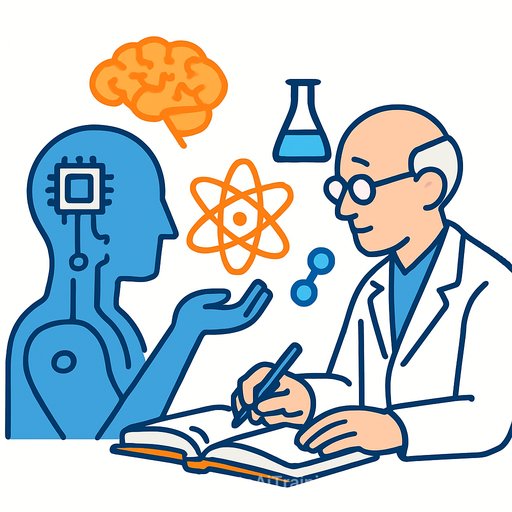
Nobel laureates in Dubai: AI can speed up science, but can't replace human discovery
At the World Laureates Summit in Dubai, more than 150 researchers and prize winners agreed on one thing: AI is changing how we run labs, teach science, and publish results. They also drew a hard line-progress still depends on human curiosity, ethics, and funding. Speakers outlined priorities for AI in Research.
AI's promise and its limits
"AI is getting integrated into every part of society and every part of science," said Ardem Patapoutian, 2021 Nobel laureate in Physiology or Medicine. He called for deliberate oversight: any powerful tool can help or harm depending on how it's used and governed.
That theme echoed across sessions: use AI to speed the grunt work, but don't outsource judgment. Scientific progress still hinges on what we choose to ask, measure, and fund.
What's already changing in labs
The shift is obvious in structural biology. "The structure of proteins… used to take five or six years," Patapoutian noted. "Now, through AI, something called AlphaFold, it's there within minutes."
That kind of step change lets teams move faster on hypothesis generation, target selection, and study Design. It also raises the bar on validation and data provenance.
- Resource: AlphaFold protein predictions and methods are documented here: EMBL-EBI AlphaFold.
Can machines actually discover?
Patapoutian put the open question on the table: many see current systems as "gathering what's known," but some believe future models may create ideas. The room was split on how far that leap can go.
Duncan Haldane, 2016 Nobel laureate in Physics, was blunt: current large language models regurgitate what's published. "The best discoveries are often unexpected, accidental discoveries," he said. Whether AI can trigger that kind of surprise is "not at all clear."
Classrooms under pressure
Haldane warned that if students offload homework to AI, they stop learning. Expect course designs to pivot to oral exams, live problem solving, and lab notebooks that show thinking, not just results. He also credited human mentors-often a single teacher-as a decisive factor in scientific careers.
Discovery still demands the unknown
Roger Kornberg, 2006 Nobel laureate in Chemistry, drew a line between prediction and discovery. "AI is limited by existing knowledge," he said. And the field is far from saturated: "We understand less than one per cent of what there is to know about human biology."
The takeaway: the next decade will be bigger than the last if we keep investing in questions that models can't answer yet.
The bottleneck isn't ambition-it's funding
Kornberg cautioned that resources trail needs. "Funds are far fewer than really needed to advance science in a way that will benefit humanity." If governments expect AI to deliver on health, climate, and growth, budgets have to match the brief.
What labs, universities, and funders can do now
- Pair AI with hypothesis-first science. Use models to narrow search space; use experiments to break assumptions.
- Require data lineage. Log prompts, model versions, parameters, and training sources so results are auditable and reproducible.
- Harden validation. Pre-register protocols, run blinded tests, and replicate across independent datasets and labs.
- Redesign assessments. Favor oral defenses, in-class derivations, code reviews, and bench work over take-home assignments.
- Invest in shared infrastructure. High-quality datasets, compute quotas, and secure sandboxes reduce shortcuts and drift.
- Fund high-variance work. Balance incremental AI-assisted optimization with grants for risky, idea-led discovery.
- Update policy. Establish guardrails for IP, biosecurity, patient data, and publication transparency in AI-assisted studies.
- Keep mentorship central. AI can draft, summarize, and simulate; it can't replace judgment earned through practice.
Why this matters
AI can clear the noise-faster screening, cleaner drafts, sharper simulations. But the signal still comes from people: the questions we ask, the experiments we design, the ethics we enforce, and the budgets we approve. Speed without direction just gets you lost faster.
Resources
- AlphaFold database and docs: EMBL-EBI
- Upskill your team on practical AI workflows for research roles: Complete AI Training - courses by job
Your membership also unlocks: