Writers: Use AI, Avoid IP Headaches
AI makes drafting faster. It also introduces legal traps that can cost you clients, time, and rights.
If you write, edit, or publish with AI in the mix, you need a simple rulebook. Here's the version you can apply today.
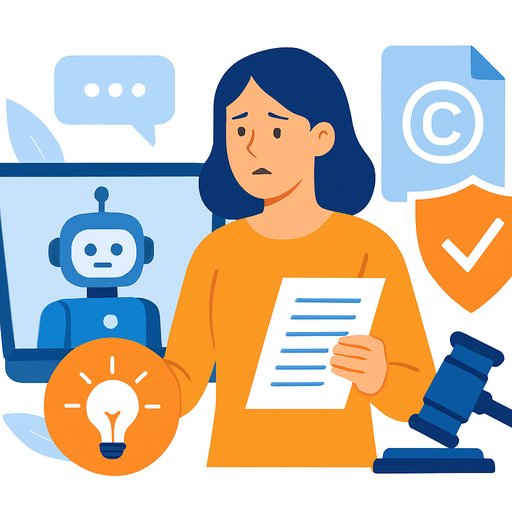
Authorship: Only Humans Own Copyright
Across major jurisdictions, copyright belongs to people, not machines. U.S. courts have held this line for years, affirmed by cases like the macaque selfie dispute and the Copyright Office's refusal to list an AI as the author of a work.
The Berne Convention centers protection on the author as a person, and many countries follow suit. Some offices have also stated that outputs with no meaningful human contribution aren't protectable at all-no human author, no work, no rights.
Berne Convention (WIPO) | U.S. Copyright Office: AI Guidance
Is Your AI Output Protectable?
Originality still rules. If a person contributes creative choices that show personal judgment, you have a shot at protection.
If the output is generated with minimal human input and you simply accept it as-is, your claim is weak. Add intent, edit deeply, and document your role.
Hidden Risk: Training Data and Lookalikes
Models learn from large datasets. That can lead to outputs that echo protected text, imagery, or style-sometimes too closely.
Logos, characters, and branded elements are especially risky. Even human-like ads can trigger "virtual doppelgänger" claims if someone believes their likeness was used without consent.
Terms You Click Matter
Most providers say you own your output but don't guarantee exclusivity. Your prompt and output may be reused for training, and providers usually disclaim liability for infringement.
Well-known IP is often blocked (try generating a global brand's logo), but lesser-known works slip through. You're still on the hook for what you publish.
Practical Playbook for Writers
- Keep a human in the loop: Make real creative decisions. Edit, rewrite, recompose. Save versions to prove your contribution.
- Check local law and tool terms: Before you publish, confirm what you can claim and what your tools allow.
- Use indemnifying providers: Prefer platforms that offer indemnities or clarity on training data and reuse policies.
- Run IP and similarity checks: Scan text for plagiarism. For visuals, check for brand elements or distinctive styles that could be tied to specific artists.
- Treat prompts as public: Don't paste client secrets or proprietary data into free tools. Assume it can be reused.
- Tighten contracts: In work-for-hire or client agreements, disclose AI use, cap liability, and define originality/warranty terms.
- Avoid likeness issues: Don't generate faces that resemble real people without a release. Stock or licensed models are safer.
- Document your process: Keep notes on prompts, edits, and sources. If challenged, this is your evidence.
- Set an internal policy: Simple rules for prompts, edits, approvals, and storage reduce risk across your team.
What This Means for Your Work
AI can speed up drafts. Your job is to add taste, judgment, and a clear audit trail.
Treat AI outputs as raw material. Make them yours through meaningful human craft, verify originality, and publish with confidence.
If you want structured help building safe, efficient workflows, explore curated tools and courses for writers: AI Tools for Copywriting and Courses by Job.
Your membership also unlocks: