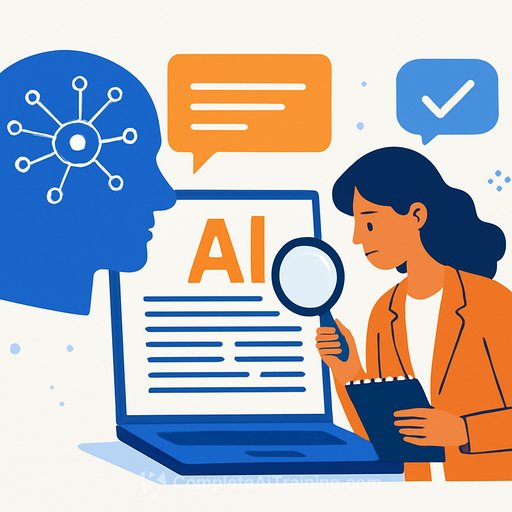
AI isn't replacing journalism - it's exposing what journalism actually is
Newsrooms are rushing to write AI policies. Some allow drafting and research help. Others swear off machines entirely. Both camps are missing the point.
We don't trust journalists because they type sentences; we trust journalists because they verify the truth.
Writing is documentation. Verification is the profession.
Think like an architect. Software draws the lines. The architect makes sure the building stands. Trust comes from responsibility, not the tool.
Journalism works the same way. The byline isn't a guarantee. The proof is in who checked the facts, traced the sources, and stood behind the claims.
What AI can do - and what it can't
AI can draft fluent text, summarize transcripts, and structure messy notes in seconds. That's useful. It removes friction from the page.
But it doesn't determine truth. It predicts plausible language. That gap - between language and reality - is where your job begins.
A practical workflow: Use AI for speed, keep you for truth
- Map claims before you write: list every assertion, number, and quote you'll publish.
- Label the evidence type you need for each claim: public record, first-party data, on-the-record source, document, photo, time-stamped post.
- Task AI with logistics: draft outlines, generate interview questions, summarize long PDFs, surface contradictions you might miss.
- Do verification yourself: pull primary documents, call a second source, confirm timestamps and locations, reproduce any calculations.
- Run an adversarial pass: ask, "If this is wrong, how would I prove it?" Then test those failure points.
- Attribute everything: link to original docs, embed quotes with context, and keep a visible chain of custody for facts.
Team policy you can ship by noon
- Permitted uses: outlining, headline options, copy edits, document summaries, idea generation, translation drafts.
- Forbidden uses: fabricating quotes, creating synthetic sources, generating unverified facts, publishing AI text without human edit and verification.
- Disclosure: disclose AI assistance when it materially shapes analysis or wording; always disclose synthetic media.
- Source control: never upload unpublished documents or confidential materials to public models.
- Logs: keep prompts, model outputs, and verification notes with the story file.
- Corrections: maintain a fast, public corrections process with a timestamped trail.
Metrics that actually measure trust
- Correction rate per 100 stories (goal: down and to the right).
- Time-to-verify for each claim class (numbers, quotes, locations).
- Source diversity: primary documents, named experts, affected parties - not just press releases.
- Link density to primary evidence per article, not secondary summaries.
Skills to level up this quarter
- Source vetting: public records, corporate filings, domain WHOIS, reverse image/video checks.
- Structured notes: claims, sources, evidence, status, last verified time.
- AI-assisted research: use models to find gaps, contradictions, and follow-up angles - then you do the checking.
- Numeracy: reproduce stats, margins of error, and methodology before you publish a single percentage.
Guidelines worth pinning
- SPJ Code of Ethics - a simple filter for every decision.
- AP guidance on AI - clear lines on use, verification, and disclosure.
For writers integrating AI without losing the plot
- AI for Writers - practical ways to draft and edit faster without sacrificing standards.
- Research - methods to pressure-test claims and fact-check AI output.
The line that matters
AI can write a paragraph. It can't carry accountability.
Your edge isn't phrasing - it's proof. Keep the speed. Own the truth.
Your membership also unlocks: