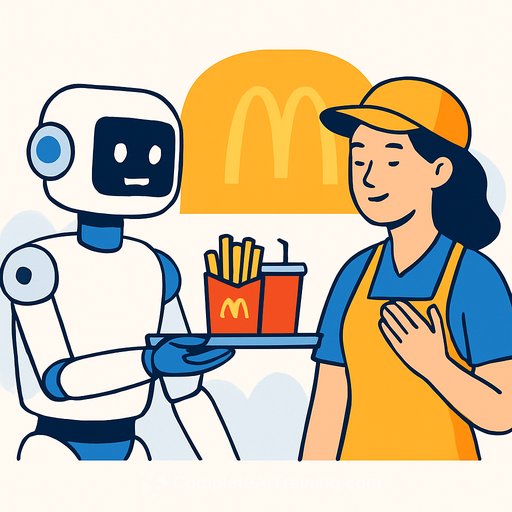
The Uncomfortable Truth About AI in Advertising
The McDonald's AI-driven Christmas spot lit a fuse for a reason. It didn't just spark a tech debate; it exposed how fragile emotion and authenticity are when execution doesn't match intent. People didn't argue about models or prompts. They reacted to how the film felt: distant, cold, off.
In advertising, message and execution are the same thing. If the way you tell the story creates distance, the message doesn't land-no matter how clever the concept. When technology becomes the main character, warmth drops, and recognition fades. Audiences feel that immediately, even if they can't explain why.
It's not about AI. It's about what AI signals
Consumers judge technology by what it replaces. When a big brand leans on generative tools, many read it as a statement about people, creativity and craft. The takeaway isn't "innovation." It's "detachment." That's the trust tax.
This pressure grows because AI is sold as faster, cheaper, easier-while its limits, quality risks and the need for constant human oversight get less airtime. Expectations go up. Tolerance for errors goes down.
The black box myth vs. the production reality
The fantasy: a prompt goes in, a finished commercial comes out. The reality: hybrid workflows, heavy direction, many iterations and relentless alignment. Complexity doesn't vanish-it shifts.
Look at the McDonald's case. Behind the scenes, a team of roughly ten people worked full-time for five weeks. That nuance got buried under a cleaner story: "tech replaced people." Inside large holdings, there's another tension. In-house AI is seen as efficient, while external production is tagged as "expensive." Financially neat, creatively risky-because the tool starts steering the idea instead of the other way around.
Where AI fits today (and where it doesn't)
- Strong fits: visual development, previs, concept testing, duplication at scale, and certain VFX layers.
- Weak fits: end-to-end storytelling when warmth, nuance and human performance carry the piece.
Tools don't make aesthetic or ethical choices. People do. The stronger the tool, the higher the bar for direction, judgment and taste.
The missing piece: environmental cost
Our industry talks a lot about sustainability-until AI is in the brief. Large-scale usage consumes significant energy and water. That doesn't vanish because we want speed. It should be part of the decision, not an afterthought. For context, see the International Energy Agency's view on AI's electricity demand here.
A simple decision framework for marketers and comms teams
For practical frameworks and case studies, see AI for Marketing.
- Start with the feeling: What emotion must the audience experience? Write that first.
- Define success beyond CPM: track trust, warmth, and recognition alongside reach.
- Pick the method last: if AI helps specific steps, use it. If it changes the feel, don't.
- Plan a hybrid workflow: clear roles for human direction, iteration gates, and quality checks.
- Address IP and data provenance early: avoid "we'll fix legal later."
- Budget for craft: directors, editors, animators, sound. Craft is not optional.
- Set sustainability guardrails: cap compute, track energy, and report trade-offs.
- Pretest for warmth: small panels catch "uncanny" signals before the internet does.
- Be transparent when it matters: if AI materially shapes the work, acknowledge it.
Guardrails for internal decision-making
- Create a "creative-first" rule: the story decides the tool, not procurement.
- Score options on audience impact, craft quality, risk, and ecological cost-then on price.
- Measure post-launch signals: sentiment, brand trust lift, completion rate, watch-time drop-offs, and qualitative verbatims.
The takeaway
This isn't a verdict on AI. It's a reminder of what audiences reward: connection, trust and recognition built over time. Speed and simplification help when they serve the story. They hurt when they replace it.
Use AI where it amplifies craft. Keep people in charge of taste, tone and ethics. That's how you protect the one asset a model can't generate for you-credibility.
If your team needs practical training on hybrid AI workflows for marketing, explore this marketing specialists certification or browse courses by job.
Your membership also unlocks: