AI won't replace teachers: What Jitin Prasada's warning means for schools and colleges
At the AI Impact Summit, Union Minister Jitin Prasada made a clear point: AI can support learning, but it cannot replace teachers. He urged the education sector to use AI to enhance curiosity and critical thinking, not erase them. His message was practical-build capacity, set guardrails, and protect students from shortcuts and misinformation. For related resources and guidance for educators, see AI for Education.
Why teachers are irreplaceable
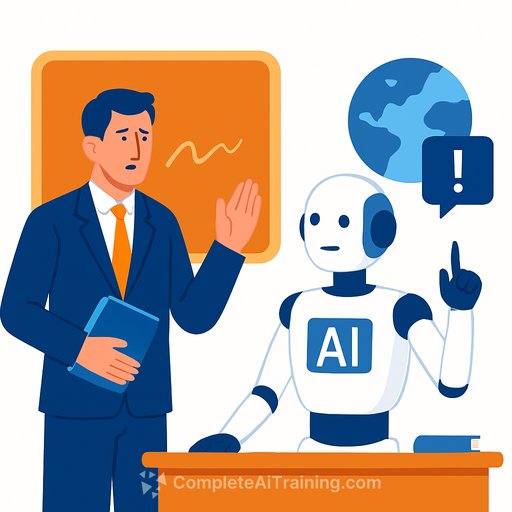
AI tutors can be helpful, but they don't bring human judgment, empathy, or the ability to read a room. As Prasada noted, an AI tutor might be "better" at repetition, but it can't replace a teacher. Use AI as an enabler-especially for feedback, differentiation, and planning-while keeping the teacher at the center.
Keep curiosity and critical thinking intact
Prasada cautioned students against using AI as a shortcut. "It's only a tool to do something faster," he said-homework still needs to be their work. For educators, that calls for assessment and instruction that reward thinking, not copy-paste.
- Design process-first assignments: require outlines, drafts, citations, and reflection notes.
- Use oral defenses, whiteboard problem-solving, and in-class writing to verify understanding.
- Teach students to prompt, verify, and iterate-then cite any AI assistance.
- Make "AI use disclosure" a norm to encourage honest, skill-building workflows.
Capacity building, not a single subject
Prasada called for integrating computational thinking across the broader educational framework-not treating AI as a one-off topic. That means upskilling teachers and building classroom routines that make AI a responsible assistant.
- Map AI use cases by subject: lesson planning, formative feedback, accessibility, and differentiation.
- Publish a simple AI policy: what's allowed, what's not, disclosure expectations, and privacy rules.
- Run short PD sprints and peer labs; adopt micro-credentials that track real classroom impact.
- Create student AI literacy modules across grades, aligned with your academic honesty policy.
Data access and safeguards
The minister said the government is working to make safe, non-personal datasets available to researchers and industry-because data fuels AI progress. For institutions, the takeaway is privacy-first adoption and tight vendor oversight.
- Prefer tools offering zero data retention or on-device processing for student work.
- Review vendor DPAs, retention windows, and training-use clauses before rollout.
- Maintain a live register of every AI tool in use, data flows, and risk ratings.
Digital literacy and election-season misinformation
Prasada warned that AI-driven deepfakes and false information can distort public opinion and harm democratic processes-especially in a country with frequent elections. Schools and colleges are on the front line of resilience.
- Teach media forensics: reverse image/video checks, source triangulation, and context analysis.
- Run simulations where students investigate and debunk a viral claim.
- Provide a clear reporting path for suspected deepfakes or manipulated media.
For classroom guidance, review UNESCO's recommendations on generative AI in education: UNESCO guidance.
What this means for school and college leaders
- Stand up a cross-functional AI committee (academics, IT, safeguarding, legal).
- Pilot 2-3 vetted tools and track impact on feedback time, differentiation, and integrity incidents.
- Embed AI literacy and computational thinking across subjects and grade levels.
- Invest in ongoing PD and coaching; measure teacher confidence and student outcomes quarterly.
If your team needs structured upskilling aligned to roles, explore targeted learning paths such as the AI Learning Path for Primary School Teachers or the AI Learning Path for Training & Development Managers.
Bottom line
AI is a strong assistant, not a substitute. Treat it as a tool that extends great teaching-while protecting curiosity, critical thinking, privacy, and civic trust.
Your membership also unlocks: