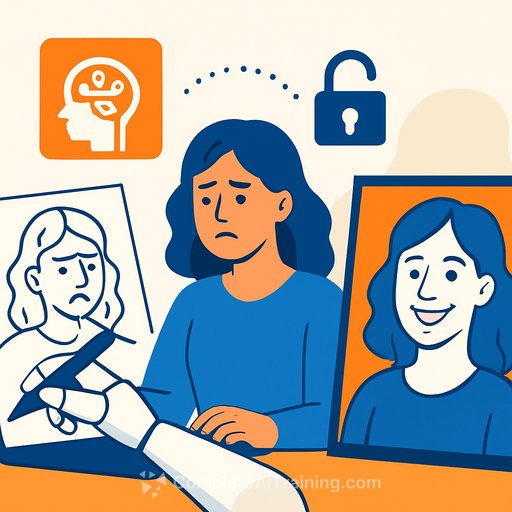
AI caricatures are everywhere. They're not free-and creatives are paying the price
Upload a selfie, answer a few questions, get a glossy caricature in seconds. It feels fun and harmless. But that "free" image is generated by a system trained on other people's work and fueled by your data-photos, chat history, and whatever you hand over to the app.
The trend is exploding. Artists are losing commissions. Researchers are waving red flags about privacy. And governments are scrambling to catch up.
The creative cost: lost work, lost conversation
Canberra artist Anne Rowlands used to pick up five or six caricature and fantasy commissions a year-$80 to $160 each. Since AI hit "good enough" in the eyes of casual buyers, those gigs have dried up.
Her portfolio spans Dungeons & Dragons illustrations and mythical creatures, like a dragon cat. What stings most isn't just the lost income-it's the hollowing out of the creative back-and-forth that makes a piece personal. If people skip the conversation with an artist, they miss the thing that actually makes custom art worth it.
She's also watching the industry push back. San Diego Comic-Con banned AI art from its 2026 show-evidence this isn't just a niche debate anymore. It's moving into events and business, and that hits real jobs.
"Built on a plagiarism machine"
South Australian multimedia artist Luku Kuku says AI video isn't threatening his work yet, but he's blunt about the inputs. Those polished portraits and caricatures echo specific aesthetics because countless creators' images were fed into training sets-often without permission or pay.
Call it what you want. For many artists, it feels like their style and sweat were used to teach a machine to undercut them.
Privacy warning: think before you upload
Digital communication professor Daniel Angus says image generation has improved fast-fewer distorted hands, more convincing faces. That makes the bait even more tempting.
He urges people to slow down before feeding apps their photos and prompts. Ask what happens if that data leaks. Check whether that "cute caricature" contains background details that reveal your location, kids' schools, or other sensitive info.
Australians are diving in anyway: the 2024 Australian Cybercrime Survey reported nearly three-quarters of people used at least one AI app in 12 months. Popular doesn't mean safe.
What to do now (practical moves for creatives)
- Set the frame for clients: Sell the value of human collaboration-idea development, sketches, iterations, and a final piece made with them, not just for them. Show your process in your portfolio.
- Productize the experience: Offer live sessions, on-site sketching, or "story + art" packages that AI can't match. The experience is the differentiator.
- Tighten contracts: Add clauses that ban using your work for AI training or dataset creation. Define licensing clearly. Require visible credit when appropriate.
- Protect your portfolio: Post lower-resolution images, crop out high-detail textures that can aid training, add visible watermarks, and remove location data from photos. Keep sensitive details out of the frame.
- Data hygiene 101: Don't link AI apps to your main social accounts. Use unique emails, restrict permissions, and avoid uploading family photos or IDs. If you'd be embarrassed or endangered by a leak, don't share it.
- Assert provenance: Where possible, use content credentials (e.g., C2PA) to label authorship and context. It doesn't stop scraping, but it strengthens your proof of origin.
- Opt-outs and reports: Use platform-specific opt-outs when available. Report unauthorized uses. Keep dated drafts and process shots to prove authorship.
- Choose better venues: Prioritize galleries, fairs, and marketplaces that prohibit AI-generated submissions and dataset use. Ask organizers to publish clear policies.
Want deeper strategies, tools, and policies creatives are using right now? Explore AI for Creatives and how artists are adapting.
Policy watch: what's changing
The federal government plans to launch an AI safety institute in early 2026. It's also consulting on copyright updates and has reiterated there won't be a general "text and data mining" exception that lets tech firms train on creative work without permission.
The message from policymakers: using creators' work for commercial gain without permission is theft. How that's enforced-and how fast-will determine whether the next wave of tools respects artists or steamrolls them.
Bottom line
People choose AI caricatures for speed and price. You win by selling the thing the model can't: taste, dialogue, and a piece that means something to the buyer. And before you feed any app your face or your files, ask the only question that matters-what happens if this leaks?
If you want to understand how these tools actually generate images (so you can counter them or fold them into your workflow on your terms), see Generative Art.
Your membership also unlocks: