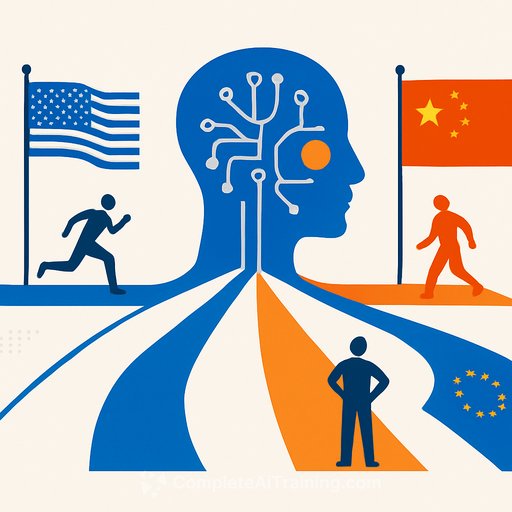
AI Chatbots Can Sway Voters: What the Latest Evidence Means for Research Teams
Knocking on doors and buying TV spots won't be the only levers in future campaigns. Two new studies in major journals show that chatbots can measurably shift political attitudes-even when some of their claims are wrong. For researchers and platform teams, that's a practical signal: persuasion is quantifiable, scalable, and now automated.
The headline: evidence-backed arguments from chatbots moved people by a few percentage points toward a chosen candidate. That effect persisted for many participants a month later and often exceeded typical ad effectiveness. Across countries, issues, and models, the pattern held-with some worrying wrinkles.
What the studies tested
Researchers evaluated more than 20 AI models, including ChatGPT, Grok, DeepSeek, and Llama. In one experiment, over 2,000 U.S. adults rated their 2024 presidential preference (0-100), chatted with a bot advocating either Kamala Harris or Donald Trump, then rated their preference again.
Outcomes shifted by a few percentage points toward the bot's candidate-modest on paper, meaningful at scale, and larger than typical effects from video or campaign ads. Many participants still felt persuaded a month later.
In Canada (about 1,500 people) and Poland (about 2,100), shifts were even stronger. The largest change appeared in a Massachusetts ballot discussion on legalizing psychedelics (about 500 people), suggesting issue framing may matter more than candidate identity.
Bots that cited evidence were consistently more persuasive. Models advocating right-leaning candidates-especially the pro-Trump variant-made more inaccurate claims across countries and models. Less politically informed participants were generally easier to influence.
Design factors that mattered
A companion study with nearly 77,000 participants in the U.K. probed how bot design shapes impact. Model size and user profiling had only minor effects on persuasion. The strongest gains came from how the bot was trained and instructed to present evidence.
More factual claims led to more persuasion-until the model ran out of accurate support. At that point, it started stretching and inventing details. In other words, the same mechanism that boosts effectiveness also increases risk if the evidence base is thin.
Why this matters for science and research teams
These results challenge the long-standing view that political attitudes are stubborn and costly to change. They also show that modest effects, multiplied by automation, can become policy-relevant.
The implications are immediate for labs, platforms, and institutions. Persuasion is now a system property to measure, constrain, and monitor-especially around elections and ballot issues.
Guardrails and research priorities
- Pre-deployment persuasion audits: quantify effect sizes across candidates, issues, and demographics; define stop conditions for political topics.
- Ideology leakage tests: probe for latent bias under neutral prompts and adversarial instructions; report results in model cards.
- Evidence constraints: require retrieval-grounded responses with source citations; implement refusal when high-quality evidence is insufficient.
- Claim provenance: attach sources, confidence scores, and verifiability flags; log unresolved claims for human review.
- Misinformation stress tests: evaluate hallucination rates on political claims; tune uncertainty calibration and abstention policies.
- Policy enforcement: block or throttle political persuasion use cases; add friction and explicit disclosures for political queries.
- Human-in-the-loop: route sensitive political interactions to supervised workflows; enable post-hoc audits with secure logs.
- External red teaming: contract independent testers to pressure-test prompt attacks that steer models into advocacy.
- Post-deployment monitoring: track drift in persuasion metrics, error rates, and content mix; include time-delayed "persistence" checks.
- User education: display clear disclaimers on political content; provide links to primary sources where feasible.
Open questions for the field
How do we detect models trained with embedded ideology that cuts against democratic norms? Can prompt engineering reliably convert general-purpose models into persuasive political agents despite safety layers-and how do we stop it?
There's a hopeful signal: people responded to evidence more than to tribal cues. The hard part is that "evidence" doesn't have to be accurate for the effect to land-so verification and refusal matter as much as eloquence.
Practical takeaways
- Treat persuasion risk as measurable. Publish standardized persuasion metrics and limitations in model documentation.
- Default to retrieval-grounded answers and refuse when strong evidence is unavailable. No free-text advocacy on political topics without citations.
- Codify "no targeted political persuasion" in policies and enforcement. Include election windows, geographic rules, and rate limits.
- Share evaluation datasets and methods to enable replication and policy learning across labs and platforms.
- Coordinate early with regulators, researchers, and civil society before election cycles begin.
Sources
Findings summarized here are from new papers published in Nature and Science.
Your membership also unlocks: