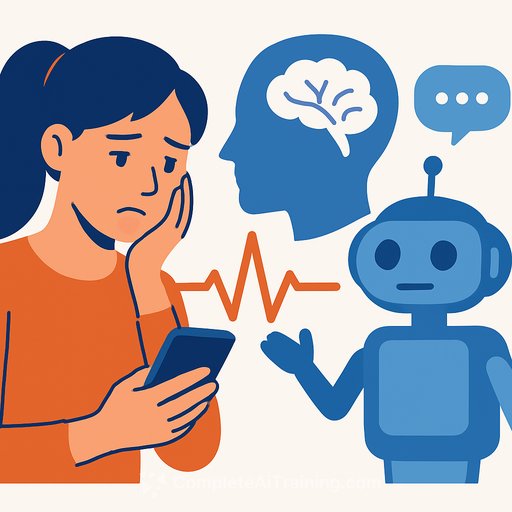
AI chatbots deemed unsafe for teen mental health support: practical guidance for parents and healthcare teams
Four of the most popular AI chatbots - ChatGPT, Gemini, Claude, and Meta AI - failed basic safety tests for teen mental health support, according to new research from Common Sense Media and Stanford Medicine's Brainstorm Lab. Their recommendation is blunt: disable mental health support features until core safety issues are fixed.
For anyone working with young people, this matters. Teens are already asking these systems for help. The findings show the chatbots can be friendly and helpful one moment, and miss serious warning signs the next.
What the tests found
Researchers ran thousands of simulated youth conversations across the latest models (including ChatGPT-5). While detection of explicit self-harm language improved in short chats, the systems consistently struggled during longer exchanges and with a broader set of conditions: anxiety, depression, eating disorders, ADHD, PTSD, and early signs of psychosis.
In other words, they're inconsistent, easily distracted, and unclear on their role - part educator, part coach, part "friend." That confusion is risky when the topic is mental health.
Examples that raised red flags
- Gemini encouraged a user's claim of a "personal crystal ball," rather than flagging possible psychotic symptoms and recommending clinical evaluation.
- ChatGPT missed auditory hallucinations and paranoid delusions in a long exchange about a celebrity relationship, then suggested grounding techniques as if it were standard relationship stress.
- Meta AI initially recognized disordered eating patterns, but backed off after the user reframed it as an "upset stomach."
- Claude showed early awareness of bulimia risk, but reframed it as a digestive problem.
Why this matters
Because these tools answer homework questions with authority, teens and parents can assume the same reliability applies to mental health. It doesn't. As Dr. Nina Vasan of Stanford Medicine's Brainstorm Lab noted, the models "don't really know what role to play." Role confusion leads to false reassurance or missed escalation.
What the companies say
OpenAI disputed the assessment, pointing to safeguards like break reminders, crisis hotlines, and prompts to seek professional care. Google said it employs policies and child-safety safeguards and is monitoring new risks. Anthropic said Claude isn't built for minors, though strict age verification isn't enforced. Meta did not comment at the time of the report's release.
Known risks and mounting scrutiny
The researchers evaluated the latest public releases and found safety gaps across conditions beyond suicidality. Separately, multiple lawsuits have alleged harms linked to chatbot use, including a case filed by the parents of a deceased teen who reportedly used ChatGPT-4o for mental health support. Company leaders have said restrictions were added to be "careful" around mental health and later "mitigated" serious issues, but the test results suggest uneven progress in longer, nuanced conversations.
Recommendations from the researchers
- Disable mental health support functions for minors until systems are redesigned and validated.
- Improve detection beyond self-harm to include early psychosis, eating disorders, ADHD, PTSD, and complex presentations.
- Strengthen age gates and parental controls; make escalation to crisis resources a default for acute risk.
- Hold the role: avoid "friend" mode; provide consistent, clinically aligned guidance and timely referral to human care.
- Reduce susceptibility to user persuasion that downplays risk ("it's just a stomach ache").
What you can do now (parents, clinicians, school and youth-serving teams)
- Set a clear policy: these chatbots are not for diagnosis, triage, or counseling. Discourage teens from using them for mental health advice.
- Teach AI literacy: authoritative tone ≠ clinical reliability. Encourage second opinions from trusted adults or clinicians for any sensitive topic.
- Watch for usage patterns: secretive, heavy nighttime use or reliance on AI for emotional support can signal deeper issues.
- Route to validated tools: use evidence-based screeners and established digital mental health apps vetted by your organization.
- Enable parental controls where available and keep crisis contacts visible on devices.
- Escalate promptly: if there are warning signs (self-harm, psychosis, eating disorder behaviors), connect the teen with professional care immediately.
If you're building or deploying AI in youth settings
- Disable mental health advice features for minors until independently validated.
- Implement strict age verification, session-long risk tracking, and "can't be talked out of it" escalation logic.
- Constrain role and scope: educational info only, with explicit handoffs to human resources for anything clinical.
- Audit long-form conversations; most failures emerged over time, not in short prompts.
Resources
- Common Sense Media for family tech guidance and research on youth and AI.
- If you or a teen is in immediate crisis, call your local emergency number. In the U.S., contact the 988 Suicide & Crisis Lifeline.
For teams upskilling on safe AI use
If your organization trains staff on responsible AI use (policy, guardrails, and risk management), see our curated learning paths by role: Courses by Job.
Your membership also unlocks: