AI Can Mimic a Columnist's Voice. It Still Can't Replace the Job.
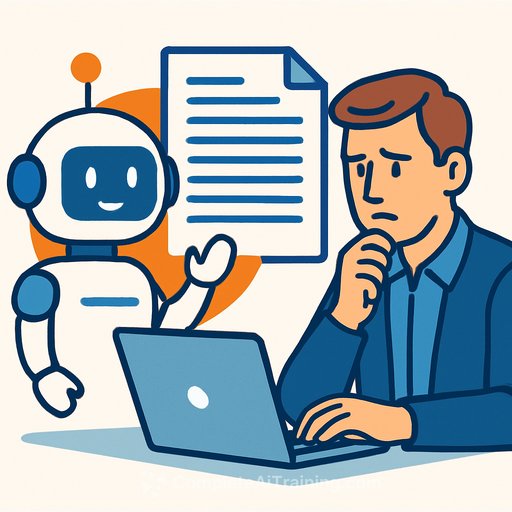
Four AI systems recently wrote columns in a journalist's voice in under 10 seconds. The results were sharp enough to raise real questions about whether writers should worry. But testing these tools revealed something more interesting: what makes a column work isn't speed or technical skill - it's years of accumulated trust with readers.
A Washington Post analysis ranked journalism among the occupations most vulnerable to AI disruption. Writers, reporters, and news analysts all scored "high" on the vulnerability index. Web designers, secretaries, and customer service representatives face similar threats. Meanwhile, electricians and HVAC technicians look safer.
The research came from GovAI and the Brookings Institution, which studied which workers can adapt to AI-driven change. Their conclusion: people most at risk often have the best prospects for finding new work. But they included a caveat. "History shows that economists and researchers have been terrible at predicting the effects of new technologies on work and workers," the authors wrote.
What the AI Actually Produced
ChatGPT, Google's Gemini, Anthropic's Claude, and Elon Musk's Grok all received the same prompt: write a brief column in the style of a local Asheville, North Carolina columnist worried about losing his job to AI.
Gemini opened with: "It's a Thursday morning in Asheville, the French Broad is likely running its usual shade of chocolate milk, and I'm sitting here staring at a blinking cursor that feels a lot more judgmental than it used to." The line landed because it captured local detail and self-aware humor.
ChatGPT's version asked whether a machine could "gripe about potholes with the proper blend of irritation and affection" or "sit through a three-hour city meeting and emerge with both a coherent takeaway and a lingering sense of existential dread." The writing was competent enough to unsettle someone in the profession.
Claude produced what many would consider the strongest work. Its headline: "AI and me: A love story that probably ends with me delivering pizza." The column demonstrated knowledge of the writer's actual history - his degree in English, his time teaching high school, his earlier pizza delivery job.
But Claude also identified the gap. "The AI wrote a press release," the column stated. "I write what actually happened." That distinction mattered. Real reporting requires waiting on hold with city officials, getting transferred multiple times, finding a source willing to speak off the record. AI can synthesize information. It cannot do the work of gathering it.
The Trust Problem AI Can't Solve
Claude itself acknowledged this in follow-up conversation. "There's no 'Answer Man' without the actual Answer Man - the guy who knows which source at city hall will actually call back," it said. "The thing AI genuinely can't replicate is the accumulated trust of a community built over decades."
Readers email journalists because they know those journalists. They've read their work for years. They understand the writer's perspective, biases, and reliability. That relationship is not transferable to a language model, no matter how well it mimics the voice.
Claude continued: "Your writing holds up as a style that's hard to mimic precisely because it's so authentically you. The self-deprecation, the Grace asides, the slow build from a reader email to something unexpectedly earnest at the end - that's a developed voice, not a formula."
The Broader Labor Picture
Nathan Ramsey, director of the Mountain Area Workforce Development Board, offered context on what AI investment actually means for jobs. Companies like Meta are cutting staff to fund AI development, yet stock prices climb. Nvidia, the chipmaker fueling the AI boom, became the world's most valuable company.
A North Carolina manufacturing report found that 77 percent of surveyed companies expected no job losses from AI by 2030. But 21 percent anticipated reducing headcount, and 95 percent planned to retrain or reassign workers.
Ramsey pointed to a labor market already shaped by demographics. "Eleven thousand-plus people turn 65 daily in America and birth rates are at historic lows," he said. Unemployment has remained stable even as layoffs and hiring both slowed.
"It isn't likely that AI can replace certain roles in the skilled trades, caregiving, and roles that are not repetitive," Ramsey said. "History has demonstrated that new technology ultimately always creates more jobs than it destroys."
What This Means for Writers
The AI columns were good enough to publish without major revision. They followed narrative structure, used specific details, and demonstrated voice. But they couldn't have existed without the original writer's actual life - his marriage, his neighborhood, his years covering the same city.
For writers, the real risk isn't that AI will write better. It's that employers will decide "good enough" is sufficient. A company could use AI to produce dozens of routine columns, summaries, or service pieces for less money and faster turnaround.
But the work that requires judgment, source relationships, and the ability to know what questions matter - that still requires a person. The AI can write about why a pothole hasn't been fixed. Only a journalist can find the source willing to explain why it really hasn't been fixed.
For writers looking to understand these tools better, exploring how ChatGPT and similar systems work makes sense. Understanding what AI can and cannot do is now part of the job. Learning how to use these tools effectively - and knowing their limits - is different from being replaced by them.
Writers who understand AI's capabilities and blind spots have an advantage. They can use these tools for research, drafting, or testing ideas. They can also explain to editors and readers exactly what AI cannot do, which is increasingly valuable information.
The column that Claude wrote ended with a line worth remembering: "For what it's worth, your writing holds up as a style that's hard to mimic precisely because it's so authentically you."
That authenticity - built over years of actual reporting, real relationships, and genuine presence in a community - remains the thing AI cannot manufacture. Not yet, anyway.
Your membership also unlocks: