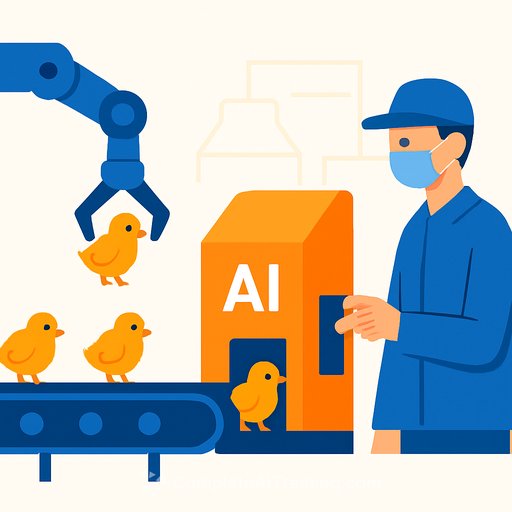
2025 Poultry Tech Summit Coverage: AI-forward chick sorting that simplifies hatchery operations
AI-powered gender identification is now sorting feather-sexable chicks - about 80% of commercial broilers - at speeds up to 160,000 birds per hour. The system uses computer vision to identify sex and automatically separates birds downstream, removing the need for conveyors and multiple workers to gap and hand-sort.
"You don't need conveyors and four other people behind the machine to actually separate and gap the birds by hand," said Ramin Karimpour, founder and CEO of TARGAN. "We are already doing it automatically in our landing zone or distribution zone."
Why operations teams care
- Throughput: Up to 160k birds/hour means fewer bottlenecks and simpler line balancing.
- Labor: Removes manual gapping/separation steps and reduces repetitive, high-strain work.
- Consistency: Computer vision improves sorting accuracy and repeatability across shifts.
- Footprint: A modular landing/distribution setup cuts extra conveyors and touchpoints.
- Uptime: Cloud monitoring plus proactive service reduces surprise downtime.
- OPEX model: Lease with pay-for-operation ties vendor revenue to your system running.
How it works
- Chicks enter an integrated landing and distribution zone that spaces birds for imaging.
- High-speed cameras capture each bird for gender determination via AI.
- Automated separation occurs downstream without human intervention.
- Cloud tools track temperature, motor loads, camera status, sensor health and operating speeds in real time.
- Managers can check performance from a phone, tablet or desktop; field service teams see issues early and act before a stop.
Operational impact and ROI signals
- Feed efficiency: Producers report 2-5 points improvement in feed conversion ratio (what FCR means), driven by more consistent flock profiles.
- Yield: 0.5-2 percentage point gains in the plant, varying by whether deboning is manual or automated.
- Line design: With peak rates, you can run fewer parallel lanes or build headroom without extra conveyors.
- Quality and welfare: Less handling reduces stress and variability at a sensitive stage.
Capacity planning quick math
At the stated peak of 160,000 birds/hour, one line could theoretically handle well over a million chicks in a standard shift. In practice, plan for your real set rate, buffers, cleaning windows and hatch window timing. Use observed hourly rates and uptime data from the cloud dashboard to set staffing and crate flow.
What to prep before deployment
- Map upstream/downstream flows (hatcher unload, trays/crates, transport buffers) and remove redundant conveyors.
- Confirm power, air and network requirements; add backup connectivity for remote support.
- Integrate key data to your hatchery MES/BI and set KPIs: throughput, mis-sort rate, MTBF, MTTR, and uptime.
- Define sanitation and biosecurity steps for cameras/sensors without adding moisture risk.
- Plan roles and training for a smaller crew focused on exception handling and QA checks.
- Stock critical spares and align maintenance windows with your hatch schedule.
Pricing and service
The system runs on a lease where payment depends on operation time. Budget this as OPEX, and review the service terms, response times and remote monitoring access your team will have. The vendor's revenue increases when your line is running, which pushes both sides toward uptime and throughput.
Background: feather sexing and automation
The approach targets feather-sexable chicks, using visual cues long established in poultry practice (chicken sexing reference). AI scales that task at speed and makes it consistent across hours and shifts.
What's next: high-speed vaccine delivery in 2026
Building on the same computer vision platform, TARGAN plans an individual chick vaccination system with similar throughput. For hatcheries processing about one million birds per week, improved vaccine efficacy could reduce disease cycling and save an estimated $2.2-$4+ million per year in feed costs, according to the company.
- Same high-speed imaging and precise targeting at the chick level.
- Operationally, expect similar dashboards, service model and sanitation considerations.
Action plan for operations
- Run a controlled pilot on one line; capture pre/post metrics for FCR, yield and labor hours per 1,000 chicks.
- Coordinate with the plant to track sex-segmented yield and debone performance.
- Evaluate flock management by sex on farm to realize the FCR gains.
- Set acceptance criteria: uptime, mis-sort rate, throughput, sanitation cycle time and service response.
Operations leaders may also consider the AI Learning Path for Vice Presidents of Operations for strategic guidance on implementing AI-driven hatchery solutions.
If you're upskilling your team on practical AI for operations and maintenance, explore role-based courses at AI for Operations.
Your membership also unlocks: