Nevada County DA Office Withdraws AI-Assisted Filing, Reinforces Verification and Ethics
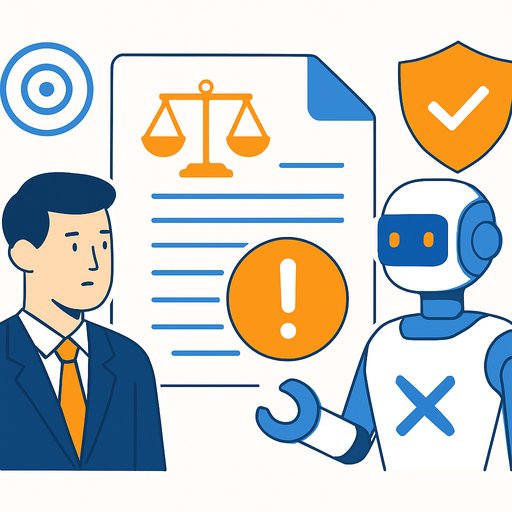
The Nevada County District Attorney's Office withdrew a filing after discovering that AI-generated content introduced incorrect legal citations. The error was caught quickly and the document was pulled before any litigation on the issue.
Opposing counsel later flagged citation errors in two additional filings. Those, too, were corrected promptly and addressed internally with the same level of seriousness-before any final resolution.
What actually happened
A prosecutor used artificial intelligence to help prepare a filing. Some citations were inaccurate. Once identified, the Office withdrew the filing and moved to tighten review and training.
The Office reiterated a baseline rule that every authority must be independently verified through authorized legal research platforms. No exceptions-no matter the tool used.
The ethical stakes
For prosecutors and all attorneys, the duty of candor to the court and accuracy in pleadings is non-negotiable. Citation errors-whether from AI output or human oversight-carry the same weight and require the same response: fix it, learn from it, and prevent it.
This incident served as a reminder: AI can speed up research, but it can also produce fabricated or misattributed authorities. Verification remains a human responsibility.
Guardrails now in place
The Office has implemented an AI Policy Directive modeled on guidance from the Judicial Branch of California and the California State Bar. All employees have acknowledged the policy, and attorneys have received AI-specific training.
- Policy adopted and acknowledged: A formal directive governs AI use in legal work.
- AI Policy Coordinator: Appointed to provide ongoing oversight and guidance.
- Training and reminders: Emphasis on diligence, competence, and candor toward the Court.
- Verification requirement: Every citation is validated using authorized research platforms before filing.
- Continuous improvement: The Office is refining processes as AI tools and risks evolve.
What legal teams can take from this
AI can be useful, but it's still maturing and prone to hallucinated citations-even within tools that look credible. The safest posture is "trust nothing, verify everything."
- Require Shepardizing/KeyCite (or equivalent) on every authority cited, without exception.
- Ban copy-paste of AI references into filings until each citation is verified in an authorized database.
- Log AI-assisted work: who used it, for what task, and what was verified.
- Redline and retain verification notes for auditability and training.
- Limit AI inputs to non-confidential data unless your tool meets your confidentiality, privilege, and vendor security standards.
- Set role-based permissions and approval flows for AI-generated research or drafting.
- Train attorneys and staff on AI failure modes: hallucinations, outdated law, incorrect jurisdictions, and citation formatting issues.
- Create an incident response playbook: withdraw, correct, notify, retrain, and update policy.
Reaffirming core standards
The Office underscored its commitment to transparency, accountability, and constant improvement. The message is clear: the source of an error does not lessen the duty to prevent it, catch it, and correct it fast.
Ethics rules already cover this: competence includes technology competence; diligence includes rigorous verification; and candor requires accuracy in representations to the court.
Helpful references
Training and upskilling options
If your office is formalizing AI policies or training, structured learning can accelerate rollout and reduce risk. Consider role-based curricula that focus on practical guardrails and verification workflows.
Bottom line: AI doesn't change your obligations-it amplifies the need for strong process. Verify everything, document your checks, and keep your team trained.
Your membership also unlocks: