Legal Education Isn't Teaching Judgment. AI Just Made That Obvious.
Classroom pilots using AI-based legal coaching revealed a gap that has long gone unexamined in law schools and law firms: judgment-the ability to weigh risks, frame advice, and navigate uncertainty-is rarely taught explicitly, despite being central to legal practice.
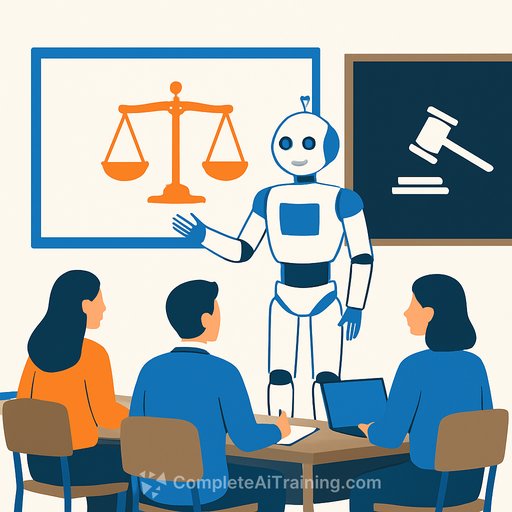
The pilots, conducted through a product counseling course, tracked how students develop judgment-based skills when working with an AI legal coach. Students received realistic scenarios and worked through them with AI support. The difference in learning outcomes turned not on whether the AI provided correct answers, but on how it explained them.
Why Explanations Matter More Than Correctness
The strongest learning gains occurred when the AI connected legal analysis to business impact, stakeholder priorities, and downstream consequences. Students retained more and engaged more deeply when they understood not just what the answer was, but why it mattered in context.
Quantitative data showed longer session times and higher completion rates when explanations tied legal issues to product decisions. In interviews, students reported feeling more confident explaining their reasoning to others, not just reaching conclusions internally.
By contrast, feedback that stopped at correctness stalled learning. Students moved on quickly but struggled to articulate why an issue mattered or how to frame it for a non-legal audience.
The distinction exposes a training blind spot: correctness is measurable and easy to assess. Judgment is not. That invisibility has allowed legal education to skip over it for years.
Framing Is a Skill, Not an Instinct
One consistent improvement was in how students explained tradeoffs and tailored advice to context. This happened because the AI modeled the reasoning process explicitly-showing how legal considerations connect to product timelines, customer impact, and business strategy.
Senior lawyers do this work instinctively. They translate doctrine rather than recite it. Yet that translation step is rarely taught systematically in law school or firm training. The pilots showed it can be accelerated when made explicit.
Students improved fastest when the AI articulated the reasoning path, not just the destination. They learned how to think about tradeoffs, not just how to reach outcomes. That learning transferred across different scenarios.
The Myth That Experience Is the Only Teacher
Legal culture treats judgment as something absorbed through years of practice, not something that can be taught directly. The data suggests otherwise.
Judgment can be developed faster when the reasoning behind it is made visible. If judgment were truly untouchable, AI would have little to contribute to legal training. Instead, the findings suggest AI can accelerate judgment development when designed to surface reasoning rather than obscure it.
This matters to firms struggling with training pipelines. It means judgment development is not confined to slow osmosis. It can be taught.
Classroom Learning and Practice Are Closer Than They Appear
A notable finding was how closely classroom dynamics mirrored law firm practice. Systems that explained context built trust. Systems that collapsed nuance undermined it. The same behaviors that supported learning also supported credibility in real client work.
This alignment challenges the assumption that education and practice require fundamentally different tools. Both environments need support for reasoning, not shortcuts around it.
Law schools and firms often talk past each other about preparedness. The pilot suggests a shared opportunity: both struggle to teach judgment explicitly. AI did not create that gap. It revealed it.
What Visibility Reveals
Before AI, gaps in judgment training were easier to hide. Senior lawyers compensated. Junior lawyers learned slowly. Feedback was uneven and informal.
AI interactions are immediate and observable. When a system explains why something matters, the impact is visible. When it does not, the absence is obvious. That visibility is uncomfortable. It is also valuable.
The pilots did not show that AI can replace judgment. They showed that legal education has relied on implicit learning for too long.
The Profession's Real Challenge
The lesson is not about technology. It is about intention.
If law schools and firms want lawyers who can exercise judgment, they have to teach judgment. That means explaining tradeoffs, modeling reasoning, and connecting legal analysis to real-world consequences. AI can support that work, but only if it is used as a teaching tool, not an answer machine.
AI did not expose a weakness in lawyers. It exposed a weakness in how lawyers are trained. That is a problem worth solving, with or without technology.
For legal professionals looking to develop these skills systematically, AI for Legal and AI Learning Path for Paralegals offer structured approaches to judgment-based legal work.
Your membership also unlocks: