
AI news ·
AI Data Center Surge Drives Global Hunt for Sustainable Energy and Grid Solutions
AI-driven data centers have surged in energy use, tripling US consumption in a decade. Companies adopt renewables and smart scheduling to balance growth with grid stability.
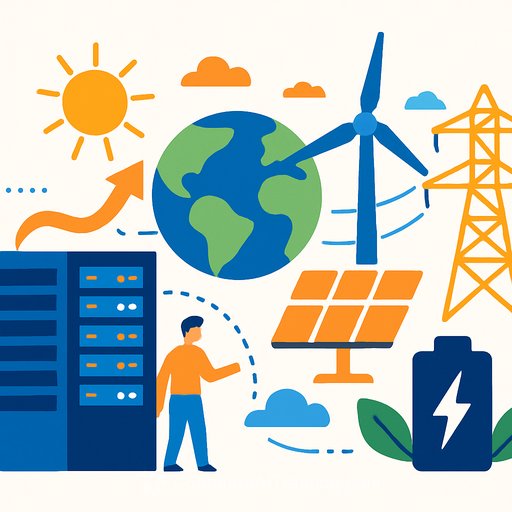
Energy Demands Reshape Global Power Grids
The growing influence of artificial intelligence (AI) is driving a surge in data center energy consumption, making these facilities major electricity users worldwide. Tech companies are actively turning to renewable energy and flexible management strategies to meet this rising demand while maintaining grid stability. Meanwhile, countries are updating regulations and infrastructure to support the booming data center industry, balancing economic opportunities with energy supply and sustainability challenges.
Data Centers: From Minor Consumers to Energy Giants
AI’s widespread adoption has pushed data centers from relatively small electricity users to significant power consumers. With chatbots and AI models now commonplace in work and daily life, energy needs are soaring. For example, US data centers consumed 50 terawatt-hours (TWh) of electricity ten years ago; today, that number has nearly tripled to 140 TWh, representing 3.5% of the nation’s total electricity use.
As energy consumption grows, tech firms increasingly resemble large industrial consumers, securing their power through long-term agreements. Amazon leads by example, being the world’s largest corporate buyer of renewable energy with over 500 power purchase agreements (PPAs) across 27 countries—comparable to the renewable energy procurement of some European nations.
Securing Sustainable Power for Expanding Data Centers
In the US, which has more than 50 gigawatts (GW) of data center capacity as of 2024, companies like Amazon, Google, and Microsoft are exploring diverse energy sources. These include solar photovoltaic (PV), battery storage, natural gas, and nuclear options such as small modular reactors (SMRs). While renewables and batteries are progressing, SMRs still need to demonstrate commercial readiness.
Globally, data center electricity demand is projected to more than double by 2030. By 2040, it could reach 1,800 TWh—enough to power roughly 150 million US homes for a year—as tech giants continue to expand their processing capabilities.
Managing Energy Use to Support Grid Stability
Although increasing energy demand may seem alarming, data centers have the potential to stabilize local power grids if managed wisely. AI model training often happens in batches, allowing data centers to control their energy consumption effectively. Techniques like power-capping limit the maximum power used by processing units, cutting energy use while only slightly increasing task completion time.
Scheduling AI workloads is another tool. Short-term scheduling shifts processing to times when renewable energy is abundant—such as solar power during the day—and energy prices are low. Long-term scheduling adjusts activity by season, running more processes in summer when energy is cheaper and scaling back during pricier winter months. These strategies can also adapt in real-time to move workloads to off-peak hours, helping balance grid demand.
Global Hotspots for Data Center Growth
As demand rises, tech companies seek locations with affordable, clean, and flexible power. Norway is a prime candidate due to its low electricity prices, abundant hydropower, and naturally cool climate, which reduces cooling costs. Norway’s flexible energy supply also supports the European grid during peak demand, although concerns about rising household electricity prices have sparked political debate.
With proper regulations, data centers can act as flexible energy consumers—buying power during surplus periods and easing grid strain. Proposals in Norway include licensing systems that factor in social benefits and waste heat utilization, as well as possible limits on data storage.
Varied National Responses to Data Center Growth
Countries are taking different approaches to data center expansion. Ireland and the Netherlands have imposed restrictions due to grid constraints, while Singapore has lifted bans and is revising laws to remain competitive in the data center market.
Market liberalization is another factor shaping data center investments. Thailand, for example, is deregulating its power sector to attract private investment. This has already led to 47 data center projects with more than $5 billion invested as of late 2024.
Balancing Growth with Energy and Policy Challenges
Meeting the electricity demand of multiplying data centers requires coordinated regulatory and development strategies. Key measures include flexible energy consumption, real-time demand response, and integrating renewables. These approaches can reduce grid pressure and price volatility while supporting decarbonization goals.
Data centers will continue to grow as a critical part of the digital economy. Their energy demands, when managed effectively, can become an asset for grid operators rather than a liability.
For those interested in AI and data center trends, exploring courses on AI infrastructure and energy-efficient computing can provide valuable insights. Check out Complete AI Training's latest courses for up-to-date learning opportunities.