AI helps decode a Roman-era board game - and proposes how it was played
March 1, 2026
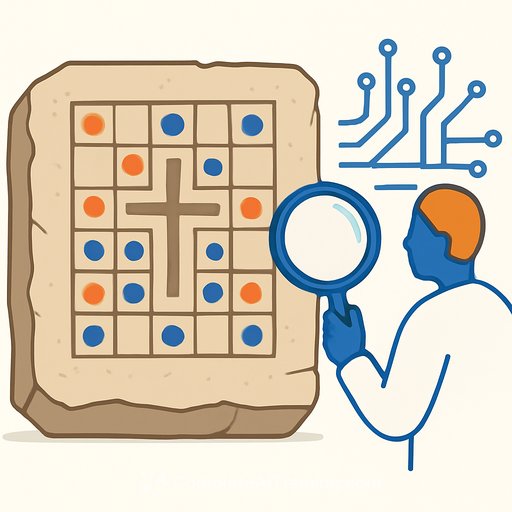
A smooth, circular limestone piece unearthed in the Netherlands and housed at Het Romeins Museum in Heerlen has stumped archaeologists for years. New analysis suggests it wasn't a tool or ornament-it was a board for a two-player strategy game.
What the stone reveals
The disc is etched with straight and diagonal lines. High-resolution 3D imaging showed some grooves are deeper and more worn than others, hinting that pieces slid along specific paths-and some paths saw more action than the rest.
"We can see wear along the lines on the stone, exactly where you would slide a piece," said Walter Crist, an archaeologist at Leiden University who studies ancient games. That wear map became the anchor for testing possible rule sets.
How the rules were inferred
Researchers at Maastricht University used an AI system called Ludii to search for plausible rule sets. They seeded it with about 100 ancient games from the same region and period, then let the system generate variations and play them against itself.
From dozens of candidates, the team filtered for versions that were actually enjoyable and strategically interesting to humans. They then cross-checked the most promising variants against the observed wear patterns to find the best fit.
Dennis Soemers from Maastricht University added a key caution: if you give Ludii any line pattern, it will find rules that work. That means the proposed rules are credible, but not guaranteed to be the exact way Romans played.
The game, in brief
The likely objective: hunt and trap the opponent's pieces in as few moves as possible. Think of fast positional play with forced routes and chokepoints created by the etched lines-simple surface, real tactical depth.
Why this matters for science
This study shows a practical workflow for studying ambiguous artifacts using computational methods. It combines physical evidence (wear), historical priors (known games), and AI-driven simulation (self-play) to converge on testable hypotheses.
- Capture: 3D scan and quantify wear intensity along lines.
- Constrain: Build a rules grammar informed by regional/game-family priors.
- Search: Use program synthesis or Ludii-like engines to generate candidates.
- Evaluate: Score with self-play (win-rate diversity, cycle avoidance, move entropy, length), then human playtests.
- Validate: Compare predicted move traffic to wear distribution; iterate.
For archaeologists and computational researchers, this is a repeatable pattern you can adapt to other etched stones, carved boards, or fragmentary game surfaces.
Limits and open questions
- Equifinality risk: multiple distinct rule sets can produce similar wear.
- Missing data: original piece counts, materials, and starting positions are unknown.
- External corroboration: look for matching game pieces, inscriptions, or depictions to narrow the search space.
How to apply this approach in your work
- Treat rule inference as model selection: define hypotheses, simulate, and rank by fit to physical traces plus playability.
- Use multi-objective scoring rather than a single metric; include human-in-the-loop testing early.
- Document priors and search bounds to avoid overfitting; preregister criteria when possible.
If you're integrating AI into field or lab workflows, explore practical methods and tools under AI for Science & Research.
Publication
The research and candidate rules appear in Antiquity: W. Crist et al., "Ludus Coriovalli: Using artificial intelligence-driven simulations to identify rules for an ancient board game" (2026).
Your membership also unlocks: