AI Agents Are Now Making Software Buying Decisions. Your Marketing Needs to Change.
Software vendors have spent decades marketing to humans. You optimized landing pages for human eyes, wrote copy for human emotions, and designed dashboards to be "sticky" for human users. That assumption no longer holds.
AI systems now handle significant portions of how software is discovered, evaluated, and shortlisted. They scan options, compare capabilities, and narrow down choices-work that once took procurement officers weeks on spreadsheets. For software companies, this changes not just how products are sold, but how they must be presented.
What AI agents actually want
AI agents don't care about brand colors, testimonial videos, or intuitive dashboards. They prioritize clarity: what the product does, how it works, and how easily it integrates.
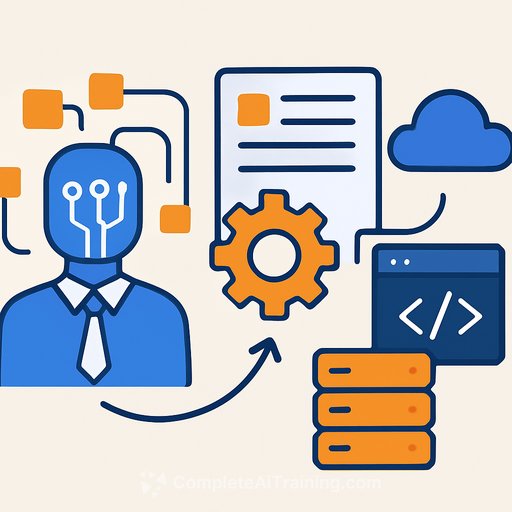
They look for "primitives"-APIs, SDKs, modular services that plug into larger systems. If your marketing doesn't highlight these building blocks, the AI agent skips you entirely. It's like trying to sell a pre-built house to someone shopping for quality bricks.
Infrastructure beats destination
Software marketing traditionally positioned products as the central hub where work happens-a destination users return to daily. In an AI-driven ecosystem, that's a disadvantage.
A destination is a silo. It requires humans to go there, stay there, and interact with it. The new goal is to become infrastructure: invisible pipes and wiring that power operations without human intervention. You want to be a component someone (or something) builds with, not a tool someone uses.
When you market as infrastructure, you speak the language of AI agents. You prove your solution can be automated, scaled, and integrated without major human involvement.
Documentation is now your sales tool
The sales deck was king in the old world. In the age of AI decision automation, documentation is your most important marketing asset.
AI agents crawl documentation to understand what your product actually does. They search for endpoints, rate limits, and compatibility schemas. If your documentation sits behind a login or lacks organization, these systems can't properly evaluate you.
Your technical content is no longer just for developers. It's for the AI systems recommending software to executives and tech decision-makers. Treat it with the same care as your homepage. Is it readable by language models? Can AI easily extract the primitives you offer? If not, you're leaving revenue on the table.
Humans are now approvers, not scouts
Humans still sign checks. But their role has shifted from scout to approver. The AI agent does the scouting, testing, and shortlisting. By the time a human evaluates your product, the decision is already heavily influenced by data the agent collected.
This means your lead generation strategy needs an overhaul. Broad-brush digital ads won't work. You need deep, reliable data on the technical ecosystems your prospects are building. You need to know which platforms they use so you can position your infrastructure as the perfect fit.
Best-of-breed beats all-in-one
All-in-one positioning appeals to users. From a systems perspective, large tightly bundled platforms are harder to evaluate and integrate.
The market moves toward best-of-breed composable stacks. Be the best at one specific thing-one primitive-and make it incredibly easy to plug into everything else. If you market an all-in-one platform, highlight the specific modules or engines that can stand alone. Show the world (and the agents) you're not a closed box.
Show the math
Vague promises of "increased efficiency" or "better collaboration" no longer persuade. AI decision engines are calculators. They want to see the math.
Lead with data transparency. Provide clear, quantifiable benchmarks and case studies showing exactly how your software performs under different conditions. The more specific and transparent, the easier it becomes for AI agents to compare and justify your solution.
Four steps to start
- Audit your primitives: Break down your software into its three most valuable building blocks. Feature these prominently in your marketing.
- Open your documentation: Stop hiding technical specs. Make documentation public, searchable, and well-structured. This is your new sales front door.
- Change your language: Move from "The only platform you'll ever need" to "The engine that powers your X workflows."
- Target ecosystems: Stop targeting just "Marketing Managers." Find companies using specific tech stacks where your primitive fits.
AI decision automation doesn't replace human judgment. It changes how decisions take shape. Software that is easy to understand, integrate, and evaluate has a clearer path into consideration.
For marketing teams, the challenge isn't reinventing strategy entirely. It's shifting emphasis toward clarity, structure, and relevance within a broader ecosystem. Learn more about AI for Marketing or explore the AI Learning Path for Marketing Managers to understand how these shifts apply to your role.
Your membership also unlocks: