Deepfakes and War: Why AI Literacy Now Matters for Educators
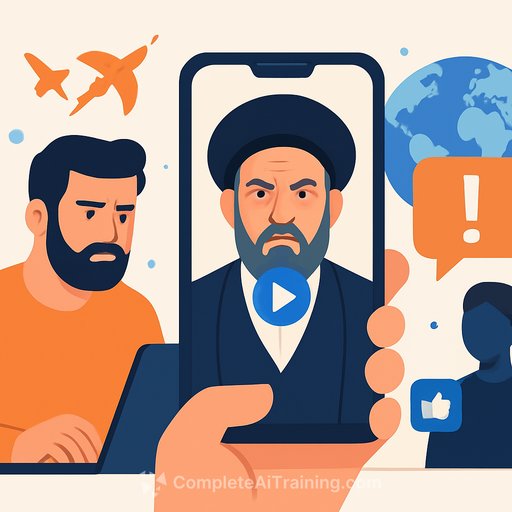
A viral video in March 2026 showed missiles striking Tel Aviv, explosions blooming across the night sky. Millions saw it. The video was fake-generated by AI, not captured by a camera.
Since the U.S. and Israel resumed military operations with Iran on February 28, 2026, synthetic videos have flooded social media. False footage of airport evacuations, bombings, and casualties spread faster than corrections. The New York Times documented a "cascade of A.I. fakes about war with Iran" across platforms.
This matters to educators because the problem isn't technical-it's educational. Without Critical AI Literacy (CAIL), students and the public cannot distinguish fabrication from reality, leaving them vulnerable to manipulation during high-stakes moments.
How Misinformation Works in Wartime
False information in conflict is not new. The U.S. used phantom attacks in the Gulf of Tonkin to escalate Vietnam. Officials claimed weapons of mass destruction existed in Iraq before the 2003 invasion. Both shaped public opinion and justified military action.
What has changed: AI and social media allow anyone to create convincing synthetic content at scale. A single person can generate dozens of deepfakes in hours. Algorithms amplify the most sensational content regardless of accuracy.
The result is corrosive. When NBC News confirmed a May 2025 video of starving Gazans was authentic, social media users dismissed it as a deepfake anyway. Once people stop trusting what they see, genuine evidence of suffering becomes indistinguishable from fabrication.
The Problem With AI as a Solution
Many people now use AI to detect AI-generated content. This creates a dangerous cycle. Large Language Models-the technology behind ChatGPT and similar tools-are pattern-recognition engines, not intelligence. Studies show they produce factually inaccurate responses roughly half the time.
Google's Gemini gave conflicting answers about whether a text was AI-generated, even when Gemini itself had written the text. News outlets citing AI detectors as definitive proof are building conclusions on unstable ground.
The deeper issue: most AI systems reflect the biases in their training data. Unmoderated models have surfaced white supremacist and extremist content. If a corporation owns the model, profit often takes priority over democratic stability.
What Critical AI Literacy Means
CAIL goes beyond teaching students how to use a chatbot. It teaches them to ask: Who owns this AI? How does that ownership shape what it says and what it hides? What biases are encoded in its training data?
Media literacy-the ability to access, analyze, evaluate, and create across all forms of communication-has been neglected in U.S. schools. Many nations made it compulsory; the U.S. left it to local discretion. CAIL builds on this foundation by adding questions about power, ownership, and algorithmic bias.
The stakes are concrete. In wartime, panic and misinformation can radicalize individuals toward violence. If deepfakes and hallucinating systems shape how people interpret conflict, they live in a manufactured crisis.
What Educators Can Do
Educators can teach students to geolocate footage, check metadata, and accept uncertainty. Verification takes time. Authentic investigation means sometimes concluding there isn't enough evidence yet-a discipline that contradicts social media's demand for instant reaction.
Students should understand that humans remain smarter than the systems they build. Prolonged, uncritical reliance on AI degrades cognitive abilities, memory, and focus. The goal is not to reject technology but to use it deliberately.
Critical AI Literacy asks: Will AI serve the common good, automating meaningless tasks to improve human life? Or will it remain an exploitative force that manufactures reality for profit? An informed public decides. An uninformed one remains dependent on the narratives designed to exploit them.
For educators, this is no longer optional. Start with AI for Education frameworks that teach interrogation of power structures. Build on AI for Research skills that help students verify claims and understand bias in data.
The fog of war is no longer metaphorical. It is literal: an information environment choked by synthetic fabrications. Only literacy-critical, sustained, and systemic-clears it.
Your membership also unlocks: