
AI news ·
AI detection tools flag human-written novels, leaving authors struggling to prove their work is their own
AI detection tools flagged one author's chapter as 100% machine-written, then 100% human after minor edits. Publishers have no clear standards, leaving authors with no reliable way to prove their work is their own.
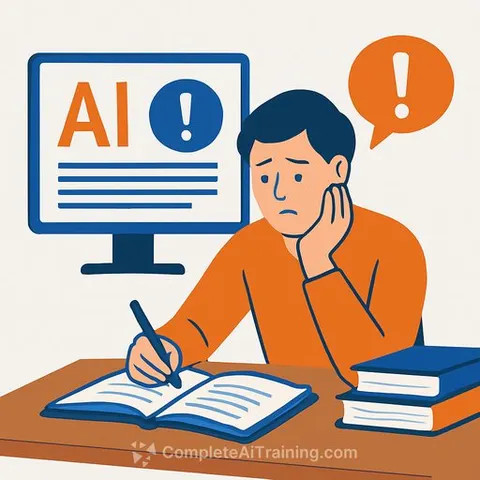
Publishing Faces a Crisis of Trust as AI Detection Tools Fail Authors
A horror novel pulled by a major publisher over suspected AI use has triggered widespread panic among debut authors, who now fear they'll face unfounded accusations of using artificial intelligence to write their work. The controversy has exposed a fundamental problem: the detection tools meant to catch AI-generated prose are unreliable, and the publishing industry has no clear standards for how writers should disclose their use of the technology.
Last month, Hachette cancelled the U.S. release of Shy Girl by Mia Ballard after finding evidence that the book had been partly produced by AI. Ballard denies writing it with AI, saying an editor she hired to revise her self-published version used the technology without her knowledge. The book had already sold nearly 2,000 copies in the UK before the cancellation.
Antonio Bricio, an engineering consultant in Mexico, completed his first novel-a science-fiction thriller about alien contact-last autumn. After collecting rejections from 20 literary agents, he began revising. When he heard about Shy Girl's cancellation, he worried that agents and publishers would avoid unknown authors out of fear they'd used AI.
Bricio doesn't use AI to write, except occasionally to translate words from Spanish to English using DeepL. But he decided to test his work anyway. He uploaded a chapter to Originality.ai, an AI detection tool, and paid for a subscription.
The detector flagged his chapter as 100 percent AI-generated. Bricio deleted some sentences and reran the test. This time, the same tool said it was 100 percent certain a human wrote it. After deleting or adding just a few more sentences, the results shifted again.
"What if publishers or agents start running these AI tools on everybody?" Bricio said. "Everybody is going to walk on eggshells from now on."
Detection Tools Produce Wildly Inconsistent Results
Bricio's experience reflects a broader problem: AI detectors are unreliable. Thriller writer Andrea Bartz tested her own published work with an AI checker called Ace and was told it was 82 percent AI-generated. The tool then offered to "humanise your text"-a solution that made clear how little the detector understood about actual human writing.
When Bartz wrote about her experience on Substack, dozens of other writers reported similar false positives. Novelist Rene Denfeld said an AI detector had also incorrectly flagged portions of her work as machine-generated.
"We're reaching this era of distrust, with no easy way to prove the veracity of your own writing," Bartz said.
Publishers Have No Clear Rules on AI Use
Most major publishing houses operate on trust, expecting authors to be transparent about AI use. But there are no clear rules about which forms of AI assistance cross a line-whether it's using the technology for research, editing, or drafting sentences.
This ambiguity has created confusion. Some writers use AI without disclosure. Others avoid it entirely but now face pressure to prove their work is human-written. Some authors have begun adding logos to their books and websites claiming "human authored" status, offered by organizations like the Authors Guild in the U.S. and the Society of Authors in the UK.
AM Dunnewin, a self-published horror author, registered for the certification. "I thought, maybe having that certificate could be a safety net, letting people know that it's my work," she said.
Readers Want the Choice
Book reviewers were among the first to spot signs of AI generation in Shy Girl. Rachel Louise Atkin, who reviews books for thousands of followers on Goodreads, Instagram, and TikTok, said she devoured the book in a day and recommended it widely before learning about the AI concerns.
"If I knew for definite that something was written with AI, I would have avoided it," Atkin said. "I think we should be able to make the choice if we want to read something that was written with AI or not."
Some writers view this skepticism positively. Young-adult author Laura Taylor Namey said readers want books "that come from the author's brain and heart and not a computer that's robbed the writer's brain." But others worry that as AI technology improves, the telltale signs of machine-generated prose will disappear, making detection impossible.
The Industry Needs Standards
Publishing consultant Jane Friedman called the situation "a wake-up call for the industry." The current state of affairs-where detection tools fail, publishers lack clear policies, and authors face baseless suspicion-is unsustainable.
Writers now face pressure from multiple directions. The number of books published annually continues to rise, making it harder to stand out. Authors who avoid AI feel compelled to prove their human authorship, with few reliable ways to do so. Those accused of AI use, whether fairly or not, find their reputations damaged and their careers threatened.
For writers like Bricio, the Shy Girl controversy has created a new anxiety: not whether to use AI, but how to prove they haven't.