
AI news ·
AI detectors falsely flag human writing at universities
University AI detectors yield false accusations, with one tool mislabeling 16% of human essays as AI-generated. This risks academic penalties and damaged reputations.
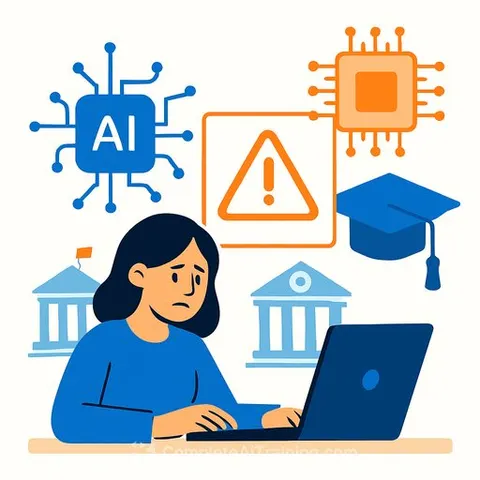
Artificial intelligence detection tools used by universities to screen writing for AI-generated content are unreliable and frequently produce false accusations, according to an analysis published in Nature. The findings raise concerns for students and professionals whose original work can be flagged as machine-written, with consequences that range from academic penalties to damaged reputations.
The problem is not theoretical. Lauren Jager, a chemistry student at Idaho State University, wrote her PhD application essays without any AI assistance. When she learned that some programs planned to scan personal statements with AI detectors, she tested her writing on several online tools. They classified her work as almost entirely AI-generated. Fearing automatic rejection, Jager rewrote her statement in a less polished style until the detectors assigned a lower AI score. She was later accepted into a PhD program at the University of Utah.
How AI detectors fail
Unlike traditional plagiarism checkers that compare text against existing databases, AI-generated writing often produces original phrasing that conventional tools cannot match. This has driven universities toward specialized detectors such as GPTZero, Copyleaks, Turnitin, Grammarly and QuillBot. However, their accuracy varies sharply. A 2025 study found that GPTZero correctly identified many AI-generated papers but falsely labeled roughly 16% of human-written essays as AI-generated. Other research showed that several leading detectors performed better on older AI models than on newer systems, while also delivering inconsistent results on genuine human writing. Even historical documents like the U.S. Declaration of Independence were repeatedly flagged as AI-generated.
Bias against non-native English writers
The technology may carry an additional disadvantage for writers whose first language is not English. A Stanford University study found that more than half of English-language essays written by Chinese students before the release of ChatGPT were incorrectly marked as AI-generated, while essays by U.S. students were classified much more accurately. Researchers attributed this gap to differences in vocabulary and sentence complexity, which can make writing from non-native speakers appear suspicious to the algorithms.
Institutional pushback grows
Legal and administrative challenges are mounting. In one case, a New York judge overturned a disciplinary action against a student accused of using AI after the allegation relied on an AI detection app. The United Kingdom's higher education ombudsman warned universities about depending on these tools following complaints from students, including one who argued the software was biased against their writing style. Several universities have also declined to adopt Turnitin's AI detection feature because of transparency concerns.
Shifting from detection to process
Many researchers now argue that the focus should move away from purely detecting AI and toward assessments that capture how students develop their work. Some institutions and technology providers are adopting tools that record drafting and editing histories, allowing instructors to see the evolution of an assignment rather than judging only the final text. For writers and educators, staying informed about these changes is essential. Resources like AI for Education explore how institutions are adapting, while AI for Writers provides practical guidance on navigating both the tool and the detection landscape.
Why this matters for writers
If you write professionally, the risk of false positives is not limited to academia. Increasingly, employers, publishers, and clients use AI detectors to screen submissions, and a false accusation can undermine trust in your work. The safest approach is to understand the limitations of these tools and to preserve evidence of your writing process-drafts, notes, and revision histories-so that you can defend your authorship if challenged. Treat AI detectors as probabilistic, not definitive, and never downgrade your writing to appease an algorithm that cannot reliably distinguish human from machine.