AI-based diagnostic tools boost TB and diabetes care across India: Key updates for government teams
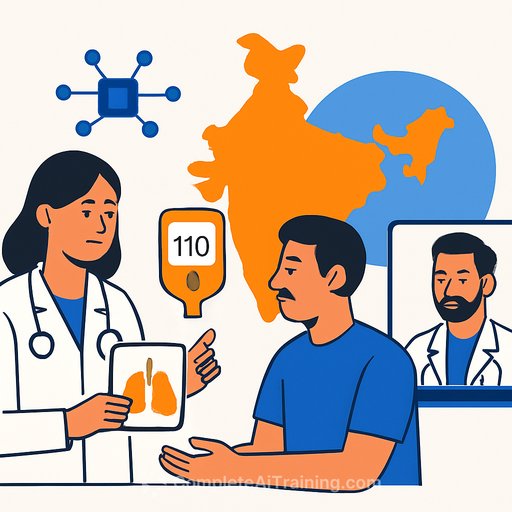
India is deploying artificial intelligence across public health services to speed up screening, improve referrals, and standardize frontline care. In a written reply in the Lok Sabha, Union Minister of State for Health and Family Welfare Prataprao Jadhav outlined how AI is being used at scale for tuberculosis and diabetes management.
The Ministry of Health has designated AIIMS Delhi, PGIMER Chandigarh, and AIIMS Rishikesh as Centres of Excellence for Artificial Intelligence to build, validate, and deploy AI solutions for health systems.
What's already live
- MadhuNetrAI (Diabetic Retinopathy): Enables non-specialist health workers to screen retinal fundus images and classify DR across standard grades for faster triage and referral.
- "Cough Against TB" (CATB): Community-level AI screening for pulmonary TB, showing an additional yield of 12-16% over conventional methods in deployed areas.
- Clinical Decision Support System (CDSS) in eSanjeevani: Streamlines complaint entry and provides AI-based differential diagnosis suggestions to improve consultation quality.
- Abnormal Chest X-ray Classifier Model: Assists with detection workflows where radiology capacity is limited.
Early results that matter
MadhuNetrAI is live in 38 facilities across 11 states. It has supported screening of 14,000+ retinal images and benefited 7,100 patients by prioritizing urgent cases for specialist referral.
CATB has screened 1.62 lakh individuals between March 2023 and November 30, 2025, lifting case finding where it's deployed.
Since April 2023, CDSS integration into eSanjeevani has supported 282 million consultations with standardized data capture across Health and Wellness Centres.
Why this is useful for government programmes
- Faster, consistent triage at the primary level, reducing missed referrals for TB and DR.
- Better workload allocation: routine cases handled locally, urgent cases moved to specialists sooner.
- Stronger data quality across facilities, enabling cleaner monitoring and timely course correction.
- Practical support for districts with limited specialist availability.
Implementation checklist for state and district teams
- Map facilities for immediate rollout (NCD clinics, HWCs, TB units) and align with existing DR and TB screening days.
- Nominate a nodal officer per district to coordinate devices, connectivity, and user onboarding.
- Train non-specialist staff to capture quality retinal images and cough audio samples per protocol; schedule refresher sessions.
- Embed AI outputs into existing workflows: referral paths, appointment slots, and follow-up registers.
- Set clear KPIs: screening volumes, referral turnaround time, additional case yield, and treatment initiation rates.
- Ensure consent, data minimization, and role-based access; log all AI-assisted decisions in patient records.
- Plan for device upkeep, software updates, and helpline support; budget for maintenance, not just procurement.
Standards, ethics, and data protection
Deployments adhere to national policies: AI Governance Guidelines by MeitY, Ethical Guidelines for AI in biomedical research and healthcare by ICMR, the Information Technology Act 2000, the Digital Personal Data Protection Act 2023, and the Information Security Policy for Healthcare by the Department of Health and Family Welfare.
Next steps for administrators
- Prioritize high-burden districts for CATB and DR rollouts; finalize a quarterly scale-up plan.
- Enable eSanjeevani CDSS by default at HWCs; track usage and feedback weekly for the first 90 days.
- Integrate AI flags with referral centers and ensure time-bound slots for suspected cases.
- Publish a simple district dashboard: screenings, positive flags, referrals completed, and treatment starts.
- Escalate blockers early (connectivity, device downtime, staffing gaps) via a single escalation channel.
If your team needs structured AI upskilling to support rollout and oversight, see curated AI courses by job role.
Your membership also unlocks: